Showing posts with label The News Makers. Show all posts

Rupert Murdoch could buy Fox regional sports networks back from Disney at a discount of billions

 by Alex Sherman

The front-runner to buy 22 regional sports TV networks from Disney is the same company that sold them in the first place.

“New Fox,” the company that will remain after Rupert Murdoch sells $71.3 billion worth of 21st Century Fox assets to Disney, is the leading contender to buy back the RSNs it “sold” to Disney as part of the larger transaction, according to people familiar with the matter. Those networks broadcast the games of 44 professional teams from Major League Baseball, the National Basketball Association and the National Hockey League

Formal offers haven’t come in yet. As Sports Business Daily reported, Disney only recently sent out its bid book to prospective buyers. News that Fox was considering buying back the channels was previously reported by The Information.

But people familiar with the process, who asked not to be named because the negotiations are private, say New Fox is the most serious buyer for all the networks. That’s a cleaner outcome for Disney than selling the networks piecemeal, which would bring in smaller buyers and private equity firms.
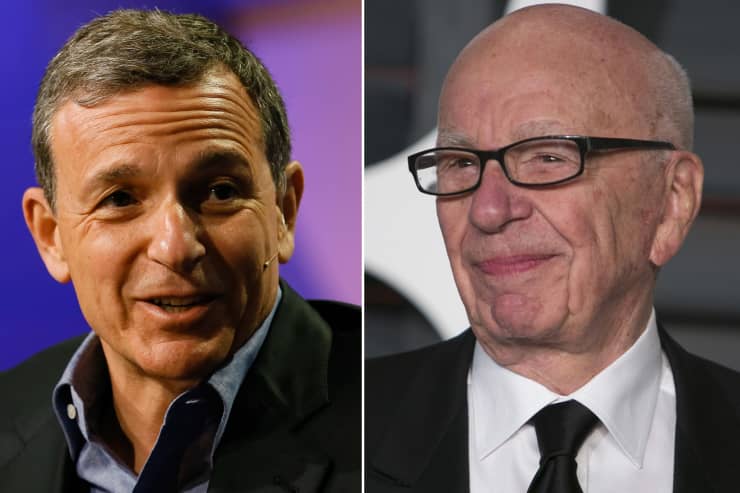
Premium: Bob Iger Rupert Murdoch split 
Premium: Bob Iger Rupert Murdoch split
Getty Images

Disney is a motivated seller because it can’t get its larger deal for Fox done without divesting the networks. The Department of Justice forced Disney, which owns ESPN, to sell the networks to alleviate concerns about too much sports programming power in the hands of one company. In fact, the networks might never even change hands, depending on when Disney’s larger deal of Fox closes.

Winning back the sports networks would be a coup for Rupert Murdoch, who could get the RSNs at a lower price than the value at which he sold them to Disney — a price that was driven up nearly $20 billion by Comcast’s rival bid for the bundle of Fox assets. There may also be beneficial tax benefits to Murdoch, related to tax-deductible amortization, one of the people said.
A declining asset that’s worth more to Fox than anyone else.
There are several ironies here.

First, while the DOJ forced Disney to sell the RSNs to get the larger deal done, the networks were never a crown jewel asset for Fox, Disney or Comcast. Fox was willing to sell them (and did). Disney took them because it wanted other assets from Fox (its studio, its stake in Hulu, Star India).

Meanwhile, Comcast saw the RSNs as an albatross and was equally willing to divest them, according to people familiar with the companies’ thinking.

Regional sports networks used to be huge value-adds for the cable industry. They carry exclusive broadcasting rights to local games, which come with devoted fan bases. About a decade ago, the networks began to hike carriage fees, knowing cable providers would agree to the higher prices rather than risk alienating customers by blacking out the networks. That led to a steady rise in the cost of cable for consumers. Residents of markets like New York or Los Angeles, which have multiple teams and a handful of RSNs, were paying fees up to $10 a month (baked into their monthly cable bill) whether or not they were watching the games.

In recent years, pay-TV providers, which have seen millions of customers cut the cord, have started to see RSNs differently. Providers have pushed to tier them onto packages that appeal just to sports fans while keeping costs lower for everyone else. This has decreased the value of the networks, which are no longer automatically part of everyone’s basic cable packages.


Several pay-TV providers have dropped regional sports networks, refusing to pay their high programming fees. For instance, SportsNet LA, which broadcasts L.A. Dodgers games, which hasn’t been carried by DirecTV for five straight years.

If Fox ends up with the sports networks again, part of the reason will be that no other large pay-TV distributor -- Charter, AT&T, Comcast or Dish -- saw value in owning the networks. While Sinclair Broadcast Group CEO Chris Ripley has discussed making an offer for the networks with private equity support, it would need quite a bit of help. Sinclair’s market capitalization is just $2.8 billion. The regional sports networks were valued at more than $20 billion, according to a Guggenheim Securities analysis.

It’s still unclear how much New Fox is willing to spend on the networks — or what Disney values them at. What is clear is that Disney needs to sell them.

Disney to divest regional sports networks post-deal.

The second irony is Murdoch can once thank rival Comcast for making him money if he ends up with the networks.

When Comcast and Disney were jockeying to buy Fox assets earlier this year, one thing was never in doubt -- Murdoch wanted to sell to Disney. Several times, Murdoch aligned himself with Disney’s bids against Comcast.

Yet, the competitive Comcast bids let Murdoch net $19 billion more for his bundle of assets.
Now, Comcast’s participation could help him get the sports networks at a bargain.

Disney originally agreed to buy the Fox assets for $52 billion. Comcast’s rival bids for Fox pushed the price up to $71.3 billion. In that process, it pushed valuation of the RSNs higher, as it did for all of the assets (including 39 percent of British TV provider Sky, which Comcast later agreed to buy).

Disney almost certainly won’t find a buyer that will pay that inflated valuation for just the networks. New Fox’s most likely competitor (barring a competitive bid from a company like John Malone’s Liberty Media) is a private equity firm -- and there’s little chance a leveraged buyout firm could win a bidding war for the RSNs and satisfy its limited partners that it would make a future return on the assets.

(Disney, by the way, will end up getting $15 billion back for selling its 39 percent stake in Sky and possibly about $20 billion for the RSNs, making that $71.3 billion Fox deal look more like $36 billion.)

It’s possible Google, Amazon or another technology company would eventually be interested in the networks for the sports rights. But that seems unlikely. The regional sports networks are tied to a legacy cable system that tech companies typically view as anathema. If Amazon or Google wants regional sports rights, they can just wait until current contracts expire and bid on them then.

The final irony is Fox’s decision to sell the RSNs to Disney may have actually convinced Murdoch that it was better off keeping them. In the months following Fox’s decision to sell, New Fox has clarified its focus, centering itself around news and sports. Netflix publicly praised the company for that decision last week.

It’s possible Fox has come to the conclusion owning the RSNs makes more sense than selling them, even if it didn’t think so 10 months ago.

Disclosure: Comcast is the owner of NBCUniversal, parent company of CNBC and CNBC.com

GIRAFFE ATTACKS award-winning movie director while shooting film in South Africa


 The last photograph of Carlos Carvalho, who was killed by a giraffe
The last photograph of Carlos Carvalho, who was killed by a giraffe
by Mike Behr
Carlos Carvalho was taken to hospital but died from head injuries after shooting scenes with a giraffe called Gerald, with witnesses saying the killer blow came without warning

A SOUTH African movie director was killed after being hit by a giraffe while shooting close-ups of the wild animal at a South African game farm.

Carlos Carvalho, 47, was shooting scenes at a British expat's game farm when the giraffe, called Gerald, swung its neck - hitting him on his head and sending him flying.
The last photograph taken of the award-winning South African director has since been shared, with witnesses recounting the devastating tragedy that unfolded on Wednesday.

Focus puller Drikus van der Merwe said: "I was standing right next to Carlos when the giraffe suddenly swung its neck and hit him on his head above his ear and sent him flying about four or five metres through the air."

He said that the animal had initially seemed to be "inquisitive", with the crew shooting close ups of its body and feet.

He added: "Then while Carlos was looking through the camera eyepiece Gerald swung his neck and hit him against his head.

"It came out of nowhere and Carlos didn’t even see it coming. He wasn’t aware of the danger.”
 The giraffe, called Gerald, was being filmed when he hit the film director
Mike Behr
The giraffe, called Gerald, was being filmed when he hit the film director 
 Carlos was an award-winning South African movie director
Mike Behr
Carlos was an award-winning South African movie director
A stunned Van der Merwe said he unwittingly captured the last photos of Carvalho alive, taking a photograph for the 47-year-old's family.

He said: "About five minutes before he got hit Carlos gave me his phone and asked me to take some photos of him on the rig for his kids.
 
"He was talking so highly of them and his wife. I feel so sorry for them."

The film crew had been at Glen Afric, a North West Province game farm where tourists can view and pet wild animals, to capture footage for a German movie Premium Nanny 2.

 A Christmas card previously sent out by the South African game farm, showing Gerald the giraffe
Mike Behr

A Christmas card previously sent out by the South African game farm, showing Gerald the giraffe
 
 The film director had been at the farm
Mike Behr
The film director had been at the farm
Carlos, who has won a number of awards including a Silver Lion at the Cannes Film Festival in 2003 for a public service announcement for Childline and a 2014 African Movie Academy Cinematography Award, was airlifted to Milpark Hospital in Johannesburg, but died about 9pm on Wednesday.

The South African game farm he was at is located in Broederstroom, 64km from Johannesburg.

Better known in the movie business as Brookers Farm, it has also been a popular filming location for hundreds of international movie and TV shoots for the last 40 years.

It is best known in the UK as the location for the ITV series Wild At Heart.
The show ran for seven series from January 2006 to December 2012.

 The giraffe will not be put down, owners of the park said
Mike Behr
The giraffe will not be put down, owners of the park said
Glen Afric spokesperson Jenny said that Carvalho had ignored safety instructions not to approach the animal, saying: "He was unauthorised to film. He went off on his own.

"He wanted to get some shots to prove a point. He was trying to excel.

"Gerald was not to blame and would not be put down, said Brooker.

“We are not going to shoot Gerald. He was not in the wrong. I don’t consider him to be a dangerous animal.”

She said unlike Shamba the lion who was shot on another South African game farm after mauling his British owner Mike Hodge on Monday, Gerald the giraffe showed “no animosity, no malicious intent".

She said: "He’s just a huge wild animal and the guy disobeyed safety regulations. I’m very sad for his family. But I’m not one of those people who blames the animals."

Disneyflix Is Coming. And Netflix Should Be Scared.

Will Disney destroy the movie theater?


Those successes, however, belie real danger on the horizon for Disney. In recent years, many of the company’s traditional strengths have slowly turned into weaknesses—like a fairy-tale castle gradually flooded by its own moat.

Take television. Disney has long prospered thanks to the cable bundle, which, like a private-sector tax system, levies a large annual fee on the vast majority of U.S. households. Disney’s most valuable network, the sports juggernaut ESPN, collects approximately $8 per cable-package subscriber a month. No other basic-cable channel makes more than $2.

But the cable business is floundering. Nearly half of adults ages 22 to 45 didn’t watch any broadcast or cable TV in 2017, according to a study by the marketing agency Hearts & Science, and the number of so-called cord cutters abandoning cable is growing by the year. This is troubling news for ESPN, whose daily viewership has declined more than 10 percent since 2011. It’s nearly as troubling for Disney, which makes more money from television than from its movies or amusement parks.

The U.S. film business, meanwhile, has arguably been in slow-motion decline since Dwight Eisenhower’s administration. The typical American bought more than 20 movie tickets a year in the early 1940s, a period in which Disney pumped out Fantasia, Pinocchio, Dumbo, and Bambi in three consecutive years. But ticket sales plunged after the rise of television in the ’50s, and they’re still falling: The typical American bought fewer movie tickets in 2017 than in any year during the previous two decades. Among the key demographic of 18-to-24-year-olds, North American movie-theater attendance has declined 17 percent since 2012, a sign of more bad news to come for Disney.

That is, if it sticks to its traditional ways of making money. Americans aren’t watching less video entertainment each year. They’re actually watching much, much more—on their smartphones, laptops, and internet-connected TVs—thanks to the rise of streaming, where Netflix, not Disney, reigns supreme. It might seem confounding that Netflix’s market value is about 90 percent of Disney’s, considering that Disney does many things profitably while Netflix has one specialty, internet video, and hardly makes a dime on it. But investors and young people agree: The future of entertainment will be streamed. And that means Netflix, with its nearly 120 million global video subscribers, has an early lead in the race to become the next generation’s showbiz colossus.

Economic history holds a rich archive of once-thriving firms that were overtaken by technological change. Far shorter is the list of companies that forestalled their demise by nimbly adapting to defeat new competition. It’s much too early, however, to count Disney out. The company is mobilizing, in two major ways, to outrun Netflix and remain the dominant player in American entertainment.

First, Disney has announced that it plans to acquire most of the assets of 21st Century Fox. If the Justice Department approves the $52 billion deal, Disney would gain possession of the 20th Century Fox film studio, including Fox Searchlight (which has produced Best Picture Oscar winners such as Slumdog Millionaire, Birdman, 12 Years a Slave, and The Shape of Water), the X-Men franchise, the FX and National Geographic cable channels, several regional sports networks, and the television production company that makes Modern Family and The Simpsons. The resulting conglomerate would own as much as 40 percent of the U.S. movie and television industries.

Second, and more important, Disney is building a streaming product to deliver its content, old and newly acquired, directly to consumers—let’s call it Disneyflix. When it launches, in 2019, it will include several exclusive series and every film in the Star Wars, Marvel Entertainment, Pixar Animation Studios, and Disney Animation universes.

Disney, in other words, is constructing what looks to be a worthy rival to Netflix. Will this be enough to inaugurate another century of dominance? Based on its public statements and on private conversations I’ve had with Disney executives, the company’s most likely path forward is to nurture Disneyflix gradually, in an effort to ease the decline of pay-TV and film—the equivalent of saving its flooding fortress by plugging each new leak as it springs. That may be a prudent way to maintain the status quo for a few more years. To save the kingdom, however, Disney may have to blow up the castle.

Black Panther, Disney’s latest box-office megahit, offers a perfect lens through which to see both the benefits of Disney’s traditional model and the virtues of a new path. The acclaimed film grossed more than $575 million at the domestic box office in its first month, showcasing Disney’s unique ability to create broadly appealing entertainment in a culture that often feels like an agglomeration of cult interests and niche tastes. But in film, as in television, Disney relies on middlemen to deliver its content—and middlemen always take a cut. To buy a ticket to see a Disney film in theaters, you pay an exhibitor that keeps about 40 percent of the ticket price.

What if Disney bypassed the middlemen and put a highly anticipated film like Black Panther on its streaming service the same day it opened in theaters—or made the film exclusive to subscribers? In the short term, sacrificing all those onetime ticket buyers might seem financially ruinous. But the lifetime value of subscriptions—which renew automatically until actively canceled—quickly becomes profound. If the film’s debut encouraged just over 4 million people to sign up for an annual subscription to a $10-a-month Disneyflix product—about the same number of subscribers that Netflix added the quarter it debuted its original series House of Cards—Disney would earn a net revenue of nearly $500 million in just the first year. Black Panther was a massive hit as a theatrical release; it could have been even bigger had it been used to transform onetime moviegoers into multiyear Disneyflix subscribers.

“If I were sitting in [Disney CEO] Bob Iger’s shoes, I would realize that the most important thing I can do is create original exclusive content for my streaming product that is unencumbered by any other platform,” Rich Greenfield, a media and technology analyst at the investment bank BTIG, told me recently. (One week later, he made the case explicit in a research report, one section of which was titled “Why Releasing All Disney Movies on Streaming Is Not Crazy.”) Among other benefits, he said, Disney would get valuable personal data on its biggest fans, which it could use to customize its video service and offer special discounts for merchandise and theme-park tickets.

The math might make this seem like an easy call for Disney, but let’s not underplay how radical this move would be, and how seismic the effects on the existing entertainment industry. In recent years, the theatrical-release business has been carried by blockbusters—and Disney has been perhaps the most reliable producer of those. From 2010 to 2017, films earning more than $100 million have grown from 48 percent to 64 percent of the domestic box office, according to the research firm MoffettNathanson—and Disney has made the year’s top-grossing film in six of the past seven years.

If Disney moves its films, en masse, to a proprietary streaming platform, it would smash movie theaters’ precious window of exclusivity and leach away crucial revenue. Exhibitors such as AMC and Regal may find themselves on an accelerated path to bankruptcy or desperate consolidation.
Zohar Lazar
This is a future, in other words, where the movie industry as we know it ceases to exist. “We’re entering a world where theatrical movie openings will be optional,” says Ben Fritz, an entertainment reporter at The Wall Street Journal and the author of a new book, The Big Picture: The Fight for the Future of Movies. “Fierce competition in streaming will put more pressure on Disney to put its best content first on [Disneyflix].” Diehards might still fork over $20 to see the new Star Wars film on a big screen surrounded by thunderous sound effects and fellow fans dressed up as Kylo Ren. But many families would begin to regard movie tickets the way today’s cable-TV subscribers regard tickets to a baseball game: an expensive way to communally experience an event already available at home at no additional cost.

The collateral damage to the TV business would be no less significant, and might give Disney executives even more pause. The House of Mouse faces converse challenges in film and television.

Disney has an incentive to leverage its studio-film business to grow its streaming service. But the success of Disney’s streaming service could also cannibalize its lucrative TV enterprise.

Nobody benefits more from the modern cable-TV industry than Disney—or has more to lose from its erosion. In its latest fiscal year, Disney made about 40 percent of its total revenue, or about $24 billion, from its television networks, including ESPN, the Disney Channel, and ABC. But since 2010, viewership for traditional television has fallen 51 percent among Americans ages 12 to 24, according to Nielsen. This decay will accelerate as Disney’s streaming service gets off the ground and fewer people feel the need to pay for cable when they can subscribe instead to Netflix and Disneyflix (and Amazon Prime Video, and HBO Go). For young people in particular, a cable subscription may soon seem as antique as going to the opera.

Will Disney have the audacity to plunge headlong into streaming? The head of Disney’s direct-to-consumer business, Kevin Mayer, has said that the company is “all in” on its streaming business. For the moment, at least, a more accurate description might be all over the place. With its pending purchase of 20th Century Fox, the company seems to be betting equally on its future and its past—adding a formidable library of content from Fox for Disneyflix, but also buying regional sports networks for the cable bundle.

The sports bet could be a particularly shortsighted one. If Disneyflix accelerates the demise of cable, ESPN and other sports networks will feel the decline especially strongly. These channels remain profitable for the moment, but they carry burdensome contracts—ESPN pays nearly $2 billion a year for its NFL rights, for example—that will become crippling if millions more viewers cut the cord. This year, Disney is launching a new ESPN subscription sports-streaming service, but for now it’s considered a supplement to cable, without marquee games, and not a true hedge against further declines in cable viewership.

Caution is a predictable strategy for any publicly traded company, perhaps even more so at Disney.

Bob Iger has enjoyed a celebrated run at the helm of the company, but many of his seemingly bold moves have actually been safe ones. He’s pleased shareholders by counting on the public’s bottomless appetite for nostalgia and lightly refurbished classics. He acquired Pixar, Marvel, and Lucasfilm—each already successful—and amped up their revenues through expanded TV and film franchises.

Streaming presents a different challenge than figuring out the latest excuse for heroes to team up. For inspiration, the company might look to its founder. In the 1950s, when Walt Disney launched Disneyland on TV and opened his eponymous theme park in Anaheim, California, he envisioned his business as an infinity loop of merchandising, in which filmed entertainment sold toys, toys sold filmed entertainment, and both sold park tickets. It’s not hard to imagine how a Disney streaming product could work the same way. Disneyflix wouldn’t carry advertisements for other brands, but it could function as a nonstop advertisement for Disney itself. With individual data on millions of viewers, Disney could customize coupons for toys and Disney-branded experiences for its biggest fans. Subscribers at premium membership levels could get special offers for Disney cruises and line-skipping passes at Disneyland and Disney World.

In this vision, Disneyflix wouldn’t just be Netflix with Star Wars movies—it would be Amazon for Star Wars pillowcases and Groupon for rides on Star Wars roller coasters and Kayak for the Star Wars suite at Disney hotels. That’s a product that could rival Netflix and create the kind of profits Disney has enjoyed during its unprecedented century of dominance. The company just has to destroy its own businesses—and the U.S. entertainment landscape—to build it.

This article appears in the May 2018 print edition with the headline “Will Disney Kill Off the Movie Theater?”


Cannes on Alert: Millions Invested to Thwart Terror Attacks at Festival


Camus/AP/REX/Shutterstock

International Correspondent

Set to unspool just 10 days after France’s fateful presidential election, the Cannes Film Festival is ramping up security measures more than ever before.

The city is spending millions to bolster security as plans are being finalized for the world’s biggest festival, starting May 17, which is expecting stars like Nicole Kidman, Marion Cotillard, Isabelle Huppert, Kristen Stewart, Joaquin Phoenix, Jake Gyllenhaal, and director Sofia Coppola.

But the question, for many festgoers, is how safe is Cannes going to be this year?

Between high-profile thieves, last year’s terror attack in Nice, rising far-right politics, and ongoing tensions with the local French-Arab community, the French Riviera has gone through a rough patch over the past few years. The pressure-cooker atmosphere has led the city of Cannes, which hosts numerous industry events such as Mipcom, MipTV, and the Cannes Lions, to ramp up its security standards to make international visitors feel secure.

The upcoming 70th edition will be the first Cannes Film Festival since the tragic attack in Nice when an Islam terrorist ran a cargo truck through a crowd watching fireworks on Bastille Day, killing 85 people, just 18 miles away from Cannes. The Nice attack took place on the Promenade des Anglais, which runs alongside the beach, like the Croisette in Cannes.

Since the Nice attack last July, the region has been more on edge than ever. The French Riviera has become a stronghold of the far right, which has stirred tensions with the French-Arab population in the region. Controversial presidential candidate Marine Le Pen, who is running against Emmanuel Macron, gathered 30% of votes in the region, the country’s highest score for Le Pen’s political party, the Front National.

Cannes mayor David Lisnard, who commissioned an audit from Israeli counter-terrorism expert 
Nitzan Nuriel following the Paris attacks in November 2015, has taken strong measures to prevent a similar truck attack on the Croisette. Substantial barriers, most in the form of huge concrete planters, were installed along the sidewalk which leads to the Palais, the headquarters for most Cannes premieres and festivities.

The city will also spend $6 million to place automatic retractable bollards at every entry point to the town, said Yves Darros, who heads up Cannes police.

After Nuriel’s report, the city increased maritime surveillance of Cannes bay and the harbor. But that didn’t stop a French internet company from mounting a poorly-handled stunt last year during the festival. Guests at the luxurious Hôtel du Cap a few miles outside of Cannes were shaken when a raft full of men in matching helmets and military-style utility vests showed up at the hotel’s dock faking a terrorist attack.

Despite having some of France’s tightest security standards, Cannes has become notorious for its high-profile heists. In 2015, as much as $19 million worth of jewelry and watches were stolen from Cartier boutiques in in the city just before the festival. Aiming to prevent such thefts, the number of surveillance cameras was increased from 400 to 550 across the city’s tourist and festival venues in the last two years.

Cannes has also recruited a wide network of 500 local volunteers plus 80 “vigilant neighbors” who 
are in charge of patrolling across the city to watch out for suspicious activity and report it to authorities.

Last year, Cannes authorities organized a simulated raid involving fake bombs in the run-up to the festival in order to prepare for a potential attack. This year, it is believed that a similar event was organized, but details of the operation have been kept under wraps. Authorities have indeed been extremely tight-lipped about revealing any details of the preparations for obvious security reasons, as well as political ones, since the presidential and legislative elections are coming up.

Darros said festival organizers have been working hand in hand with various authorities at local and regional levels to ensure top-level security in and around the Palais.

“I’ve been doing the festival for 35 years and the security has always been great, but this year it will reach new heights,” said Darros, who also pointed out that, like last year, daily meetings with authorities and security staff will be held during the fest in order to adjust the level of security needed.

A top American sales agent with offices on the Croisette said, “We have been talking internally about measures to take if anything happens — from communicating with each other right away to make sure everyone is safe, to securing the office if needed.”

Cecile Gaget, head of international co-production and distribution at Gaumont, said she was concerned when she arrived in Cannes last year, but felt more secure when she saw snipers around the Palais from the rooftop of her office.

Some stars will arrive with their own security staff, who would have to be cleared by Cannes authorities and the festival staff. When it comes bodyguards bringing their own guns on the Croisette, they would need to be registered not only by the regional prefecture, but also by France’s interior ministry, according to a source.

France, which has been under a State of Emergency since the Paris attacks of November 2015, was just listed in the travel alert issued by the U.S. State Department on Monday, which mentioned the continued threat of terrorist attacks throughout Europe.

Citing recent attacks in France, Russia, Sweden, and the United Kingdom, the U.S. State Department said ISIS and al Qaeda “have the ability to plan and execute terrorist attacks in Europe.”

Apple Sets Its Sights on Hollywood With Plans for Original Content

The technology giant has been in talks with veteran Hollywood producers about buying rights to scripted television programs. Photo: lucy nicholson/Reuters
 
By Ben Fritz, Tripp Mickle and Hannah Karp
Apple Inc. is planning to build a significant new business in original television shows and movies, according to people familiar with the matter, a move that could make it a bigger player in Hollywood and offset slowing sales of iPhones and iPads.

These people said the programming would be available to subscribers of Apple’s $10-a-month streaming-music service, which has struggled to catch up to the larger Spotify AB. Apple Music already includes a limited number of documentary-style segments on musicians, but nothing like the premium programming it is now seeking.

The technology giant has been in talks with veteran producers in recent months about buying rights to scripted television programs. It also has approached experienced marketing executives at studios and networks to discuss hiring them to promote its content, said people with knowledge of the discussions.

In addition to TV, Apple indicated to these people that it is considering offering original movies, though those plans are more preliminary.

Executives at Apple have told people in Hollywood they hope to start offering original scripted content by the end of 2017.

The shows Apple is considering would likely be comparable to critically acclaimed programs like “Westworld” on Time Warner Inc.’s HBO or “Stranger Things” on Netflix.

Because it is looking at just a handful of carefully selected shows, and potentially films, it doesn’t appear Apple is preparing to spend the hundreds of millions or even billions of dollars it would need to spend annually to become a direct competitor to Netflix Inc., Amazon.com Inc.’s Prime Video or premium cable networks.

Rather, it would escalate the arms race between Apple Music and Spotify, which both offer essentially the same catalog of tens of millions of songs, by adding other content that could distinguish Apple’s service.

Nonetheless, the entry of the world’s most valuable company into original television and films could be a transformative moment for Hollywood and mark a significant turn in strategy for Apple as it starts to become more of a media company, rather than just a distributor of other companies’ media.

In addition to its music-related nonfiction shows and documentaries, Apple Music already has bought the rights to a half-hour version of “Carpool Karaoke,” which is currently a segment on CBS’s “The Late Late Show with James Corden.” It is also making a quasi-biographical series about Dr. Dre, the rap star and Apple Music executive, which is slated to premiere later this year.

But it hasn’t yet bought scripted content from outside producers, a more expensive and riskier endeavor that takes it further onto the turf of entertainment companies. The series and movies Apple is now considering buying don’t have any particular relationship to music, according to the people familiar with the matter.

One reason Apple hasn’t yet completed a deal to buy a scripted series is because it is still working out details of its business strategy built around original content. But it has told producers that a key advantage it hopes to offer is that it would share data on how many people watch its original content and some demographic data on them. Netflix doesn’t share any such information with its content creators, which has been a source of contention among some in Hollywood.

Apple has been flirting for years with whether and how it should enter the entertainment business. It held talk with television companies about offering a “skinny bundle” of networks over the internet, but was never able to reach terms. It also approached Time Warner Inc. last year about a possible merger before that company agreed to be acquired by AT&T Inc.

The move into original content comes as Apple is grappling with a slowdown in its traditional business. Last year it missed its own internal revenue targets for the first time in at least seven years as sales of the iPhone 6s fell short of expectations. Sales of the iPhone, which turned Apple into the world’s most profitable company, have slowed amid rising competition, particularly in China.

Apple Music has become a key piece of the company’s services business, which has been growing as iPhone sales slow. Revenue from Apple Music rose 22% in the quarter ended Sept. 24, but the service’s subscriber base is still dwarfed by Spotify’s.

Apple Music said in December that it had more than 20 million subscribers, most of whom pay $9.99 a month; Spotify counted more than 40 million paying subscribers in September.

Write to Ben Fritz at ben.fritz@wsj.com, Tripp Mickle at Tripp.Mickle@wsj.com and Hannah Karp at hannah.karp@wsj.com

The Netflix Backlash: Why Hollywood Fears a Content Monopoly


by Kim Masters

The streaming service is spending $6 billion a year on content, choking basic cable and brusquely rattling the relationship business of the town as fears of a Google- or Apple-sized dominance send a chill down the entertainment industry's spine.

Not many months ago, an original series landed on Netflix to some critical acclaim. Viewership, of course, was a mystery, but the launch seemed to make some noise. Yet the show's creator — hardly a no-name player — began to fret. There had been no congratulatory call nor even an email from anyone at Netflix.

That's a far cry from the way relationships long have been managed in Hollywood, but sources who do business with the streaming service say the silence was not atypical. "Really celebrating or valuing some of their successes — they just don't do that," says one agent.

Still, at a time when business is tough all over in the entertainment industry, there is a lot of gratitude for a deep-pocketed buyer that is snapping up an array of material, much of which might not find a home elsewhere. Netflix and its chief content officer Ted Sarandos are at once a savior, offering a giant gush of money to license shows that in some cases were past their prime or even out of production, and a terrifying competitor to studios.

"Out of the blue Netflix comes into the market and says, 'We're going to give you a number [to license a network show],' " says one television agent. "For the studios, it was, 'Holy shit. Do we even need a cable sale?' They all got addicted to crack. Nobody really thought they'd be a competitor on the originals market. They used stuff from the studios and became important. Now you see the backlash."

The backlash is real but muted — mostly because few are willing to risk the wrath of a company that is spending $6 billion a year on programming and scored 54 Emmy nominations this year. But some executives, producers and agents who rely on deals with the streaming giant nonetheless increasingly view Netflix as an existential threat.

Studios and cable channels fret that the company, with its 83 million global subscribers, is sucking up so many eyeballs and bidding up prices for programming so high that they won't be able to compete. And agents worry that as Netflix elbows out competing buyers, the company's growing insistence on buying up all rights to its original programming around the world will do away with the profit participations that on breakout shows (such as Modern Family) provide steady income in an unsteady industry. "We love the money and we can still grow our clients [by getting them Netflix deals]," says one agent. "But I'm worried about the long term. If backends go away, what's the future? This is why CAA and WME have diversified."

Hastings and Orange Is the New Black creator Jenji Kohan at the 2014 AFI Awards Luncheon in Beverly Hills.

Netflix generally declined to comment on THR's questions but asserts that it and other streaming services have sparked the creation of "huge numbers of programs," as one company insider puts it, generating more opportunity and money for the industry.

That's one point of view. Another was offered by John Landgraf at the July gathering of the Television Critics Association in Beverly Hills, where the FX Networks chief warned that Netflix could be bucking for a Silicon Valley-style near-monopoly in entertainment, such as that enjoyed by Google in search or Amazon in shopping. "I think it would be bad for storytellers in general if one company was able to seize a 40, 50, 60 percent share in storytelling," said Landgraf. The clear implication: If Netflix amasses such clout, the generous deals will start to evaporate and creative freedoms could be curtailed.

Some assert that the latter already has happened. Sources say, for example, that Beau Willimon, who adapted the British series House of Cards to give Netflix its first breakout original, was taken off the show after its fourth season because he pushed back hard on notes from Netflix execs. Willimon declined comment.

House of Cards producer Dana Brunetti also refused to comment on the Willimon exit, but the outspoken executive does say Netflix no longer offers the artistic freedom that lured the creators of the drama there. "There's nothing special about Netflix anymore," says Brunetti (who has stated publicly that he has shorted Netflix stock). "They had the first-mover advantage with digital streaming and giving artists more power, but now they've become like any traditional network or studio. And there are a lot of competitors." (Worth noting: Brunetti now is an executive at Relativity Media, which has been in a legal dispute with Netflix over the streamer's so-far-unsuccessful efforts to escape a rich deal for Relativity films after the latter filed for bankruptcy in July 2015 — before Brunetti was hired. Relativity emerged from Chapter 11 protection in March.)

Still, few can ignore the billions that Netflix has thrown around. Even though Landgraf said he'd prefer not to hand any content to Netflix, his company in July made a deal giving the streaming service exclusive rights to its American Crime Story series, pocketing what is said to be about $50 million just for the lauded first installment, The People v. O.J. Simpson.

There's plenty more where that came from. "Anybody who's going to spend $6 billion or $7 billion a year on library and original content deserves to be applauded," says ICM Partners' Chris Silbermann. 

"Do you know how bad this business would be if their $6 billion went away tomorrow?" (For reference, HBO will spend a bit more than $2 billion this year.) Netflix provides the cash up front and orders two seasons of most series — appealing in a business in which many shows are canceled in the first season.

While it remains an open question whether Netflix will become the Google of Hollywood, there's ample evidence that it already presents a tough corporate tech culture that doesn't cater to sensitive showrunners and others who are used to being handled with more care. In many cases, Netflix is a black box for show creators and producers who have business at the company. Several say they have no idea how their show will be marketed, if at all. They get no feedback on how their show is received. There are no metrics, so rewards for success aren't built into a deal (though compensation may be increased if a series' budget goes up).

Few in Hollywood have the courage to speak publicly about Netflix, and those who have projects there say they are subjected to unusually onerous restrictions on what they are permitted to say, if anything. Retired NFL player Trevor Pryce, who sold the animated series Kulipari: An Army of Frogs to Netflix, jokingly references Fight Club — "The first rule of Netflix: You do not talk about Netflix" — in an interview that soon will air on my KCRW show, The Business.

In its sole response to THR, a Netflix spokesperson offered this: "We are doing something that's never been done before; bringing great stories to people all over the world at the same time and at unprecedented quality and scale. In doing so, we are disrupting traditional business models and creating new norms. Not everyone likes disruption, but we've hired executives with extensive Hollywood and international media experience who are thriving at Netflix, and we are working successfully with a wide variety of creators and studios who understand and appreciate our approach. 

Most importantly, consumers and viewers like what we do, and we plan to keep doing it."
•••
How times have changed in the six years since Time Warner CEO Jeff Bewkes dismissed upstart Netflix as "the Albanian army." Netflix's revenue since it launched its streaming service in 2007 grew from $1.2 billion to $6.8 billion in 2015. It has 47 million subscribers in the U.S. and 36 million abroad (by comparison, ESPN has roughly 90 million subscribers). It is in 190 countries, with shows in 20 languages. Netflix expects to release more than 30 original series, or 600 hours of original scripted programming, this year — stunning when one remembers that the service's brilliant opening gambit, House of Cards, only premiered in February 2013.

Says HBO chairman and CEO Richard Plepler: "I have nothing but respect for Netflix. Anybody who does not tip their hat to what they've done in the last six or seven years is not being fair."

Next year, Netflix, with 2,800 employees, will move the 600 now packed into offices on Maple Drive in Beverly Hills into more than 200,000 square feet in the 14-story Icon building under construction in Hollywood at Sunset Bronson Studios. The company is expanding at its Silicon Valley headquarters, too.

The only thing growing faster than Netflix's footprint is the hope among many in the town's establishment that some combination of factors will slow the juggernaut. Maybe the studios will hold back programming. Maybe well-funded competitors — especially Amazon — will find a way to block Netflix. Maybe key talent will become wary of doing business there. Maybe Netflix will spend itself to death as it rebaits the hook to keep subscribers and lure in more.

The stock market noticed when the company revealed in July that growth in the second quarter was not as robust as anticipated. The company added 160,000 U.S. subscribers and 1.52 million in overseas markets, far fewer than the 500,000 it had projected in the U.S. and 2 million abroad. The company said price increases were to blame for cancellations that drove down its numbers, but price hikes had yet to go into effect for more than half of its U.S. customers, whose rates changed in the second half of 2016. On an analysts call, CEO and co-founder Reed Hastings apologized for the volatility and declared, "The big picture is very much intact."

Certainly Netflix is far cheaper than cable, and subscribers can access a cornucopia of content, from an intense drama like Narcos to a comedy as weird as Maria Bamford's Lady Dynamite. There are documentaries, children's programs, Adam Sandler movies and Beasts of No Nation. "They're like a giant shopping mall," says one agent. "They're trying to fill those spaces with something for everyone. They literally are trying to fill every space."

Despite the company's ability to know exactly what is being watched and for how long, the service isn't immune to the unpredictability that's made Hollywood a pretty crazy place for a century or so. Sarandos acknowledged during a recent THR roundtable that Stranger Things, which was spurned elsewhere but became a summer hit, was a "big surprise."

A less happy surprise, it seems, was Baz Luhrmann's musical drama The Get Down, said to have cost in excess of $120 million for 12 episodes. Despite generally positive reviews, the first six episodes landed in August almost silently. Production troubles are said to have strained Netflix's relationship with its partner on the project, Sony Pictures Television (which shouldered some of the cost overruns). Subsequently, Netflix cut the third season of Bloodline — another series on which it partners with Sony — from 13 episodes to 10. It also notified Sony that the show's third season would be its last, though it had been anticipated that the series would have a fourth season. Netflix also slashed licensing fees on the show. Both Netflix and Sony deny there are tensions between them, and Sony television still has a lot of business with Netflix.

If Netflix was daunted by the big spend on The Get Down, it is keeping its game face on. At the THR roundtable, Sarandos hinted that an upcoming series about the royal family, The Crown, might be even more expensive. And in a recent interview with The Economist, Hastings further rattled his already nervous competitors by suggesting that his company might be willing to spend a lot more. If shows like The Get Down or HBO's Game of Thrones cost $10 million per episode, Hastings mused, "what does $20 million-an-hour television look like?"

Netflix chief content officer Sarandos and actress Winona Ryder after the Los Angeles premiere of Stranger Things on July 11.

Netflix also is unafraid to spend big on movies. It is said to be paying Brad Pitt $20 million to star in the satire War Machine. And it recently committed $90 million to make Bright, with David Ayer directing and Will Smith starring. Netflix knocked two or three studios out of the bidding for the film, which sources say would likely be tagged with an R rating if it were released theatrically. As that not only would have narrowed the film's prospective audience in the U.S. but also would preclude a run in China, no other studio wanted to spend more than $60 million on the project. Sources say nearly half of Netflix's $90 million will go to buy out profit participations. And Ayer will reap about $10 million for directing, a big step up from the roughly $5 million he got to handle the writing and directing on Suicide Squad.

Netflix also is making smaller movies that otherwise might be homeless. "As sellers, we're glad they're on the block," says producer Michael De Luca, who recently set up a film based on Sarah Pinborough's YA novel 13 Minutes at Netflix. On such projects, says another film producer, Netflix buys out the backend and offers about 20 percent over production costs — "equivalent to what [profit participants] would have gotten from a studio on a modest hit."

With Netflix offering no metrics, it's impossible to know whether the upfront compensation is a windfall or falls short of what a film would have earned through a conventional theatrical release. The upside is that money is assured and there is no risk of reading horrifying box-office numbers on a Saturday morning. But for some filmmakers, a theatrical run still has meaning, and a deal with Netflix means giving that up. Unlike Amazon, Netflix has refused to open up an exclusive window for exhibitors — one reason why Nate Parker chose to sell The Birth of a Nation to Fox Searchlight in a Sundance auction even though Netflix offered millions more.

Edward Snowden appearing live via satellite for Snowden screening

(The Guardian/Getty Images)

by Will Robinson •

Snowden theatergoers next month have a chance to hear from the man himself.

Edward Snowden will appear live from Russia via satellite on Sept. 14 for a rare conversation, two days before director Oliver Stone’s thriller has its U.S. release. Stone will conduct the 45-minute interview and appear live from New York via satellite.

The NSA whistleblower has primarily remained in Moscow after leaking classified documents in June 2013 about secret global surveillance programs. Snowden was granted three-year asylum by the Russian government. Since going into hiding, Snowden has appeared via satellite numerous times, including after a Comic-Con screening of the biopic last month.

Joseph Gordon-Levitt plays the titular former government contractor who dramatizes Snowden’s life before the leaks and their aftermath. Shailene Woodley portrays Snowden’s girlfriend Lindsay Mills, and Zachary Quinto plays Guardian journalist Glenn Greenwald.

China's richest man set to seal two billion-dollar U.S. film deals


By Matthew Miller and Shu Zhang
BEIJING (Reuters) - Real estate and entertainment conglomerate Dalian Wanda Group Co expects to seal two billion-dollar film-related deals in the United States this year, chairman Wang Jianlin said on Tuesday, as China's richest man steps up his push into Hollywood.

After completing the acquisition of two non-production film companies - each worth above $1 billion - Dalian Wanda's next target would be a so-called "Big Six" movie studio, Wang told Reuters in an exclusive interview.

"My goal is to buy Hollywood companies and bring their technology and capability to China," Wang said.

He declined to elaborate on the two deals in the pipeline, which would further bolster Wanda's motion picture empire.

In January, Wang splashed $3.5 billion to buy a controlling stake in U.S. film studio Legendary Entertainment, behind hits such as "Jurassic World", making Wanda the first Chinese firm to own a major Hollywood studio.

Dalian Wanda, which was added to the Fortune Global 500 list this year, aims to triple revenue from its cultural division, led by entertainment, sports and tourism, to 150 billion yuan ($22.6 billion) by 2020.

Reuters reported last month that Wanda has held talks with Viacom Inc <VIAB.O> about acquiring its stake in Paramount Pictures, one of Hollywood's "Big Six" studios that also include Twentieth Century Fox <FOXA.O>, Warner Brothers <TWX.N>, Walt Disney <DIS.N>, Universal Pictures <CMCSA.O> and Columbia <6758.T>.

"We are interested not only in Paramount, but all of them. If one of the Big Six would be willing to be sold to us, we would be interested," Wang said.

"Only the six are real global film companies, while the rest are not. If we are to build a real movie empire, this is a necessary step."

Dalian Wanda is leading a slew of Chinese firms that are investing in Hollywood. They include Fosun International, which has invested in Studio 8, a production company started by former Warner Brothers executive Jeff Robinov, and Huayi Brothers Media Corp <300027.SZ>, which is producing films with STX Entertainment, a studio invested in by Chinese private equity company Hony Capital.

Dalian Wanda would also start co-investing in global blockbusters next year, Wang added.

A SCREEN NEAR YOU
The Chinese conglomerate, which began as a property developer in the northeastern city of Dalian, was also looking to extend the world's biggest motion picture theater network, Wang said.

Following the completion of its acquisitions of London-based Odeon & UCI Cinemas Group and Carmike Cinemas Inc <CKEC.O> in the United States, Dalian Wanda would control 15 percent of global box office revenues, Wang said, and may reach its goal of controlling 20 percent earlier than its target of 2020.

Wang, who has also bought Swiss sports marketing firm Infront Sports & Media AG and World Triathlon Corp, owner of the "Ironman" franchise, said he was primarily interested in acquiring entertainment and sports companies in the United States and Europe.

"If the target company fits our appetite, there is no upper limit for budgeting," he said.

But he cautioned that too many investors were rushing into the "hot" film market.

"Most of the money invested in China, and even the global film industry, is silly money. Only a little is smart money," he said.

"As China's film industry growth slows to below 20 percent, or even 10 percent, 8 percent this year, some will be washed out. It's like Warren Buffett said, 'you only find out who is swimming naked when the tide goes out'."

IPO OR BACKDOOR LISTING
Separately, Wang said that Dalian Wanda Commercial Properties Co <3699.HK>, Wanda's real estate flagship, would re-list on the Shanghai stock exchange either through an initial public offering (IPO) or a backdoor listing.

Shareholders of the Hong Kong-listed firm last week approved a buy-out offer that would see the firm privatized.

The company said earlier this month it planned to de-list from the Hong Kong stock exchange on Sept. 20.

Wang said both options were on the table for the planned Shanghai re-listing. Approval for an IPO could take two or three years, while a backdoor listing would require more than a year, he added.

Mainland-listed firms typically command higher valuations than those traded in Hong Kong, helped by a large pool of retail investors.

But Wang said the "core problem" that triggered the de-listing plan was not the low valuation of the company's Hong Kong shares, but the lack of liquidity.

"We only listed 14 percent of the company in Hong Kong, which means 86 percent of shares are neither liquid nor could be pledged as collateral," Wang said. "That's not a real listed company."

($1 = 6.6533 Chinese yuan renminbi)

DreamWorks CEO Jeffrey Katzenberg Seals $391 Million Payday


Senior Film Reporter
 
 
UPDATED: DreamWorks Animation shareholders had already cashed in on the sale of the cartoon studio in April, when Comcast’s acquisition brought them $41 a share, a near 50% premium for the company that created “Shrek” and “Kung Fu Panda.”

The public owners laughed all the way to the bank … or the yacht dealership. On Tuesday, executives and board members got their turn — with outgoing CEO Jeffrey Katzenberg’s more than $391 million cash-out leading the pack. The founder (along with Steven Spielberg and David Geffen) of one-time uber studio DreamWorks SKG turned in more than 10.2 million DWA shares and options to score the ginormous payday, a regulatory filing showed.


That lines up roughly with the $395 million that research firm Equilar forecast back at the time of the sale. It also should vanquish any lingering concern about Katzenberg being left out in the cold, since his move out of the chief executive’s suite and into a position as a consultant for DreamWorks’ online efforts — headlined by AwesomenessTV.

A friend of the man once in line for the throne at Disney (before he was jilted by then CEO Michael Eisner) confirmed Katzenberg’s eye-popping good fortune — though the friend came up with a slightly more modest $385 million total.

Sources said Katzenberg got to sell a total of 9,186,260 shares he held variously via direct ownership, a trust and a series of entities he owns with his wife Marilyn. That part of the deal netted him more than $376.6 million. He also got to exercise options on more than 1 million additional shares, priced at $24.28 a share and at $35.30 a share — bagging $14.9 million more.

Disney President Ann Daly got the second biggest payday, at just under $40 million. Like Katzenberg, the bulk of that came via the sale of shares at the full price of $41 a share. With more than 886,000 shares, that netted Daly more than $36 million. Added to nearly $3.5 million more from options sales, Daly takes home a total of more than $39.8 million.

Compared to the two top corporate dogs, the haul for a couple of other DreamWorks officers looks almost parsimonious. Chief Financial Officer Fazal Merchant received about $3 million, while Chief Counsel John Chang netted roughly $2.5 million.

Katzenberg could not immediately be reached for comment. Reports that the mogul was eyeing an offer on Disneyland’s Matterhorn, with Toontown thrown in, could not be immediately confirmed.

Filed Under: