Showing posts with label Film Making Techniques. Show all posts

'Star Wars': X-Wing Zooms In To Hollywood for 'Rogue One' Premiere

Courtesy ABC7


Star Wars has definitely landed in Hollywood.

Preparations for Saturday's Rogue One: A Star Wars Story premiere have already seen some big road closures on Hollywood Blvd. — and on Tuesday, an X-Wing was spotted in the area where the stars of the film will gather in a few days.

Pictures quickly spread on social media, as apparently keeping an X-Wing secret is even trickier than keeping plans for the Death Star under wraps.

For those not fortunate enough to see the film early at Saturday's premiere, Rogue One: A Star Wars Story hits theaters Dec. 16.

Creativity and psychosis share a genetic source: study

Artistic creativity may share genetic roots with schizophrenia and bipolar disorder, according to a study published on Monday.

The research, published in the journal Nature Neuroscience, delves into a well-known genetic database -- the deCODE library of DNA codes derived from samples provided by the population of Iceland.

The authors first compared genetic and medical data from 86,000 Icelanders, establishing a DNA signature that pointed to a doubled risk for schizophrenia and an increase of a third for bipolar disorder.

The next step was to look at the genomes of people engaged in artistic work.

Those samples came from more than 1,000 volunteers who were members of Iceland's national societies of visual arts, theatre, dance, writing and music.

Members of these organisations were 17 percent likelier than non-members to have the same genetic signature, the study found.

The finding was supported by four studies in the Netherlands and Sweden covering around 35,000 people, comparing individuals in the general public and those in artistic occupations.

Those investigations used somewhat different parameters but found the probability was even higher, at 23 percent.

"We are here using the tools of modern genetics to take a systematic look at a fundamental aspect of how the brain works," said Kari Stefansson, head of deCODE Genetics, who led the study.

"The results of this study should not have come as a surprise because to be creative, you have to think differently from the crowd, and we had previously shown that carriers of genetic factors that predispose to schizophrenia do so," he said in a news release.

Christopher Nolan Urges Hollywood to Step Up Efforts to Preserve Film

Christopher Nolan Horizontal - H 2014

One month after Kodak announced deals with the Hollywood studios to keep film alive — at least for the foreseeable future — Nolan addresses the issues: "It's very important to support film now."

AP Images

In February, the Hollywood studios inked deals with Kodak to keep film alive, for at least the foreseeable future. But speaking Sunday at an event presented by the Getty Research Institute, film proponent Christopher Nolan warned that more still needs to be done to preserve the medium and argued that Hollywood shouldn’t position film against new digital technologies but rather find a place where they can co-exist.

Nolan and visual artist Tacita Dean argued these points during a panel moderated by Kerry Brougher, director of the Academy Museum of Motion Pictures. “We need film projectors and film prints — forever,” Nolan said, relating that film is a different medium compared with digital and the issue comes down to creative choice. “If you want the choice, it’s very important to support film now. 

Filmmakers are going out of their way to shoot film and talk about it. We want to see a world where there's a choice; it’s important to preserve it for future generations.”

Dean discussed film at risk in the art world. "Art institutions should project a piece of art so that it can be seen in the medium that it was made. We have to persuade some institutions," she said. "We had two mediums [film and digital] and they want us to go back to using just one of them. ... [Creative and aesthetic differences] have been completely lost in this discussion about image quality."

Nolan also feels a sense of urgency to present film as a proven long-term archival medium. "We don't have a uniform standard for preservation and archiving for the studios, at the Academy, or at archival institutions," he warned. "There's no stable digital archiving medium, [at least not] in the immediate future. If there is, it would need to be tested for decades.

"The library value of film is extremely important,” Nolan reminded the capacity crowd. "Preserving films photochemically is essential." Pointing out that Hollywood is already starting to use 4K and discussing 8K resolution, he added that film archiving "works and is resolution independent ... and future proof."

As to projection, North American theaters have almost entirely converted to digital, but Nolan argued that quality “35mm projection can be a selling point for a theater.” Citing his latest film, Interstellar, he reported that theaters that showed the movie on film “did incredibly well. … We spoke about it in our advertising."

During the session, Nolan also addressed the argument that film is more expensive than digital for cinematography. "Whatever your budget level is, what you are spending money on is people and their time, overwhelmingly,” he said. “The idea that you can't afford it  [is a misconception].”

The program ended with Jeff Clarke -- CEO of Kodak, the last remaining maker of motion picture film -- joining the panelists on stage. He asserted: “Kodak is all in to film now. I couldn’t say that six months ago. … We still lose money but we are committed because we believe this is important artistically and that this is a business that will come back.“

E-mail: Carolyn.Giardina@THR.com Twitter: @CGinLA

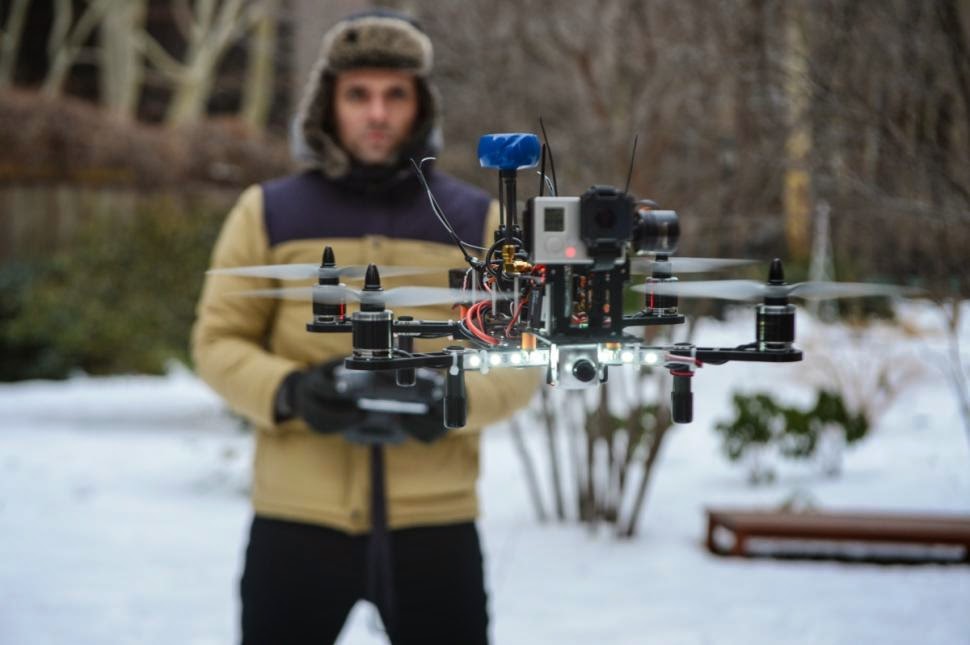
Drones Are About to Change How Directors Make Movies


I’m facing off against Thor. With a drone. Well, that’s the story I’ll tell, anyway.

I’m in Calvert Vaux Park in Brooklyn, trying to learn how to fly Horizon Hobby’s 350 QX3 AP Combo drone. Winter Storm Thor—not, alas, Dashing Hunk Chris Hemsworth Thor—is threatening to drown my drone in frigid rain. 

Steve Petrotto, Horizon Hobby’s exceedingly patient brand manager, is giving me an excellent lesson in drone cinematography. Despite his best efforts, it looks like my dream of capturing the perfect aerial shot might be dashed. This thing is pretty simple to fly, but my thumbs have the grace of Kanye West at an awards show. Instead of sweeping panoramas, I mostly just capture up-down, back-and-forth, and so on. There’s also a lot of random spinning.
 
But I know it’s possible; I’ve seen it before. In the fun short YouTube film Superman with a GoPro, filmmakers from Los Angeles used a camera-carrying drone to create a movie that looks a lot like what the Man of Steel’s forehead-cam footage might look like. I saw the same trick in Aerial NYC

Those folks made it look so easy, but it turns out I may not be the Superwoman of drone cinematography.

But despite my n00b status this little white quadcopter—it’s about the size of a backpack and feels lighter than the average hardback book—executes what moves I do try surprisingly well. And I know, because Petrotto told me, that the drone’s camera has three-axis stabilization, so my images should look smooth, even if my cinematography skills are wonky.

Then, just when I’m thinking “Hey, I could drop $1,000 on one of these. I could be the Quentin Tarantino of drone filmmaking!” Petrotto takes control. I was trying to swoop the drone past us and got a little too cavalier.

“Sorry, I got nervous there,” Petrotto says, using his “buddy box”—the drone equivalent of the brake pedal your driver’s ed instructor always used—to steer my quad well clear of a lamppost.

Surprisingly, after only a couple close calls, I start to get the hang of it. Turns out, filming with a camera-equipped drone isn’t hard at all. The controls, familiar to anyone who ever used a remote-control car, are easy to operate. The hardest part is keeping an eye on the drone and another on the smartphone displaying its video feed (they’re connected via WiFi). Soon I’m speeding around the park, trying different angles. I even manage a “dronie,” which is of course a selfie taken with a drone. 

It’s easy to see why this is the new favorite trick of a lot of cinematographers out there.

The emergence of pilotless aircraft presents some very unique opportunities for filmmakers. With drones, things like aerial shots and even crane shots become much easier and more viable. That beautiful 70mm swirling shot of Julie Andrews in The Sound of Music? Today a relatively cheap rig operated by a really good pilot could capture that with no problem.  Think of it as the most epic “dronie” of 1965.

And now that the Federal Aviation Administration is starting to allow the use of drones by aerial photography companies working with Hollywood studios and high-definition cameras are getting more durable and compact, those formerly tough and expensive shots are only going to get easier. The cinematic possibilities are vast—and definitely give unmanned aerial vehicles (UAVs) a better rap than drones used for war or surveillance get.


“It’s like when you look at your iPhone, it has more production capabilities in your little handset than NBC had in the 1990s—they surely couldn’t shoot in HD and edit and all that other stuff without millions of dollars worth of gear,” says Randy Scott Slavin, the founder of the New York City Drone Film Festival being held this weekend. “It’s the same with drones—people are taking drones to the ends of the earth and shooting beautiful amazing things that in the past would’ve cost—I mean, actually, who knows if it even would’ve been possible?”

By way of example, Slavin mentions a recent Good Morning America segment tagged “Game of Drones” in which Eric Cheng from DJI—another company that produces drones for filmmaking—got an amazing aerial shot of an erupting volcano in Iceland that was way too dangerous for any human camera operator to go near. The footage was beautiful, it looked like a nature documentary, and was captured from a safe distance nearly a mile away. (“…When we flew right over it, it was hot,” GMA meteorologist Ginger Zee understated.)

And capturing images previously unattainable, or attainable only by spending thousands of dollars a day or helicopters, is just the start of what drones can do for movies. “Drones literally go to places people couldn’t get to,” Slavin says, noting that the possibilities for drones for documentary filmmaking are particularly exciting. “I have a small drone that fits in a backpack. I can take it on my back, travel wherever I want and get amazing footage.”

Indie filmmakers like Slavin are in a good position to be at the forefront of drone cinematography. As long as they follow local ordinances and few other guidelines (the very helpful web site Know Before You Fly gives most the details amateurs need) they can power up their drones and get all kinds of incredible shots, Petrotto tells me. 

Commercial outfits working with Hollywood studios need to get the go-ahead from the FAA, but the agency started allowing exemptions for that kind of filming late last year. (Previously, movies like Skyfall and the Harry Potter films had used drones, but they’d been shot outside the US, where they’re permitted.) There’s talk that the rules may change for civilian use of drones—the FAA is under a congressional mandate to craft some by September 2015, though they could miss that deadline—but Slavin says he imagines one day getting the right clearance to film a drone shot won’t feel that much different to filmmakers than getting permission to close off a street to film a chase scene.

Slavin’s festival, with its inaugural event Saturday, will showcase the possibilities UAVs offer to pros and amateurs alike while also making people ponder what, exactly, “drone filmmaking” is. The festival’s 35 films—culled from 152 eligible submissions—represent a wide swath of the kinds of movies that can be made using drones—from fun bits like the music video for OK Go’s “I Won’t Let You Down” to more sci-fi offerings like Our Drone Future. Slavin, himself a music video director who found viral fame with Aerial NYC, says the goal is to show what’s really possible with drone cinematography.

So whereas most film festivals have categories like “Narrative” or “World Documentary,” the Drone Film Festival is honoring things like “Technical Flying” and “X-Factor.” There is, of course, a more standard “Narrative” section, but even that one has less-conventional films like Superman with a GoPro.


The festival’s more nuanced categories also demonstrate that at this point in the drone filmmaking world, the medium is still the message. A lot of drone films are experiments to see what can be done. 

Eventually, those techniques will, hopefully, just become another toolset cinematographers can use, like tracking or Steadicam shots. Until then, the use of drones for filmmaking is far from common, so film festivals like Saturday’s are necessary to celebrate an art form many in the film world don’t know exists, and would have no idea how to use.

 Luckily, though, directors are born tinkerers, so learning a new trick comes easy. It’s even a bit fun.

“I think filmmaking as a profession shares a lot 
with drones in that it is both a very technical profession aligned with something that has a lot of expression and artistry and craftsmanship in it, so the same learning curve applied to drones,” says Nikolas Pueringer, one of the directors behind Superman with a GoPro. “But it’s always just nice to experiment.”

There are, of course, technical hurdles to full-fledged drone filmmaking beyond learning to fly a drone. (FYI, Pueringer says it’s a little easier to do if you’re a gamer like he is.) Image quality and stabilization are still a challenge, and the battery life of drones doesn’t allow for long shoots—if the UAV is carrying something as heavy as a Red camera the flight time can be as little as three minutes. 

But for directors willing to learn how to do it, or hire pilots that have, the future of “drone shots” (let’s just start calling them that now, yes?) is wide open.

However, it turns out the “how to do it” part isn’t so easy if you’re not already a filmmaker.

Back at the drone flying grounds, I’ve realized that while it didn’t take long to learn not to hit things, my shot-framing skills aren’t the work of a true auteur. Thor’s rains have pushed us back into our car and Petrotto pulls up my work on his Samsung Galaxy S5. It sports a cool bird’s eye view of the Earth, but my attempt to swoop the camera around and capture my very own Julie Andrews Moment was little more than spinning the camera around in a motion-sickness-inducing twirl. Most of my “dronie” is the top of my head as I stare down at the controls.

We laugh and call it a day, but heading back into the city I think, “I could get better at this…” And I’m sure I’m not the only one.

CNN Teams Up With the FAA for Reporter Drones

AR Drone Product - H 2013

The cable network is upping its efforts to include unmanned aerial vehicles into its newsgathering


Consumers may still be waiting for their toilet paper to arrive by drone, but unmanned aerial vehicles will soon help deliver their cable news.

CNN announced Monday that it has entered a deal with the Federal Aviation Administration to integrate drones into its newsgathering and reporting.

"Our aim is to get beyond hobby-grade equipment and to establish what options are available and workable to produce high-quality video journalism using various types of UAVs and camera setups," said CNN senior vp David Vigilante. "Our hope is that these efforts contribute to the development of a vibrant ecosystem where operators of various types and sizes can safely operate in the US airspace."
 
The pact, technically dubbed a Cooperative Research and Development Agreement, will integrate CNN's existing research collaboration on drones with Georgia Tech Research Institute. The new partnership is already underway, and the FAA will use the existing data to best decide how to use drones in reporting.
 
"Unmanned aircraft offer news organizations significant opportunities," added FAA administrator Michael Huerta. "We hope this agreement with CNN and the work we are doing with other news organizations and associations will help safely integrate unmanned newsgathering technology and operating procedures into the National Airspace System."
 
Drones are hard to avoid in the media these days. Just yesterday, the Golden Globes set a drone lose above its red carpet.

Hollywood filmmakers to fly drones on movie sets


The Federal Aviation Administration proclaimed a new era in aviation in September when it granted permission to six Hollywood filmmakers to fly drones on movie sets, a decision that opened the door to commercial drone flights in the United States.

“These companies are blazing a trail,” Transportation Secretary Anthony Foxx said at the time. “We are thoroughly satisfied these operations will not pose a hazard to other aircraft or to people and property on the ground,” added Michael Huerta, the chief of the FAA.
 
What the FAA did not reveal, however, was that senior officials had overruled objections from some of its safety inspectors, who had warned after a formal review that the filmmakers’ plans were too risky and should be prohibited, according to documents and e-mails obtained by The Washington Post.

The warning turned out to be prescient. On Wednesday, a camera-toting drone operated by one of the filmmakers, Pictorvision, flew off a set in California and disappeared, according to an FAA report. Tom Hallman, the president of Pictorvision, said crew members found the 20-pound drone the next day in “rugged terrain” on a private ranch about 100 yards from where they had been filming near Santa Clarita. He said no one was injured.

Since giving the go-ahead to Hollywood cinematographers three months ago, the FAA has been swamped with requests to fly drones from other companies. As of Friday, 167 applications from an array of industries were pending, and the government is bracing for hundreds more next year.
Several FAA employees, speaking on the condition of anonymity for fear of retaliation or losing their jobs, said supervisors are pressuring analysts to rubber-stamp the applications without a rigorous safety review.

“There’s huge political pressure to do quick approvals,” said one former FAA flight safety official. “Congress made very clear what they want, and safety is not at the forefront because of pressure from the industry.”

Safety inspectors said they were being marginalized in other ways. Last month, the FAA hired a lobbyist for the Hollywood filmmakers and other companies that want to fly drones. His task? Suggest ways to speed up the approval process.
 
“How is this not a conflict of interest?” Lance Nuckolls, an FAA safety inspector, complained in an e-mail to colleagues. “I’m now officially numb with total dismay and disgust with our leadership.”

After The Washington Post raised questions about the arrangement, the FAA acknowledged that it had been a conflict of interest and said it ended the contract Thursday.

The FAA’s caseload is cresting at a critical time and is aggravating disagreements within the agency over how to open the nation’s skies to drones. Cheap, easy-to-fly drones equipped with video cameras have become hugely popular with consumers and hobbyists. But in the absence of clear safety standards and effective oversight, the robotic aircraft are interfering with air traffic and threatening passenger planes.

Since June 1, pilots have reported 25 near-collisions with rogue drones and about 150 other incidents in which drones were spotted in forbidden airspace. Although most weighed only a few pounds, aviation experts said they could have caused a midair disaster if they had struck a plane or helicopter in a vulnerable spot.

Drones can also hurt bystanders on the ground. According to an FAA document, four people have been killed in recent years around the world after remote-controlled aircraft crashed into them.
James H. Williams, the head of the FAA’s unmanned-aircraft integration office, declined an interview request or to comment for this story. Last month, during a panel discussion at a drone-industry conference in Tysons Corner, Va., he said the agency always puts safety first.

“There are approximately 48,000 people in the FAA, and as far as I know, all of them have an opinion on unmanned aircraft integration, so coordinating across that body is an interesting challenge,” 

Williams said. “The FAA remains committed to our primary mission of safety, and that’s safety not only for the other aircraft in the air but for people and property on the ground.”


In a statement provided to The Post, the FAA said its drone application process was “rigorous” and “transparent.”


“The safety case for each application is thoroughly analyzed and the rationale for each decision is publicly available,” the FAA said. “As with any emerging technology, there is a very active debate about how to approach integration, and the FAA has decided to take a staged approach.”
Struggling to keep up
Bogged down by staff shortages and a slow-moving regulatory structure, the FAA has failed to keep up with rapid technological advances in the drone industry.

Although Congress has ordered the agency to integrate drones into the national airspace by September 2015, U.S. officials expect the FAA will miss the deadline by at least two years before it can finalize regulations for drones weighing less than 55 pounds. Devising rules for larger drones will take even longer.

Until then, the FAA has stitched together an interim patchwork of guidelines. Businesses are prohibited from flying drones without special approval. Recreational drone flights are allowed as long as the aircraft stay below 400 feet and five miles away from an airport. The military and other government agencies need a certificate to fly in civilian airspace.

The guidelines, however, are routinely ignored by drone enthusiasts. With an estimated half-million small drones spinning around America’s skies, the FAA has been overwhelmed.

To alleviate pressure from lawmakers and drone manufacturers to adopt a permanent set of rules more quickly, the FAA announced in May that it will offer a temporary remedy.

The agency said it will consider granting approval to certain types of low-risk businesses — such as pipeline inspectors, filmmakers and corporate farmers — to fly drones weighing less than 55 pounds. Requests would be reviewed on a case-by-case basis.

Within days, applications started pouring in.

Insurance giant State Farm wanted to fly 15-pound drones over houses to conduct roof inspections. Chevron and Dow Chemical wanted to use drones to keep an eye on their oil, gas and chemical plants. Amazon.com wanted to test drones to see if they can reliably transport packages to customers’ doorsteps (Jeffrey P. Bezos, the chief executive of Amazon, also owns The Post).

Each of those cases is pending. The FAA has said its policy is to make a decision on each application within 120 days. It met that timetable for the Hollywood filmmakers but has struggled to keep up with the avalanche of new cases.

From the outset, several FAA aviation-safety inspectors complained that senior officials were more interested in speedy approvals than ensuring safety, according to documents and e-mails.

“As I’ve said before, we can do this job ‘good’ or we can do it ‘fast,’ but we can’t do it ‘good and fast,’ ” James Ryan, an aviation-safety inspector, said in a July 24 e-mail to the FAA official in charge of reviewing the applications and several other colleagues.

No anti-collision systems
Satellite-guided drones can be purchased for less than $500 and flown right out of the box. But their affordability and simplicity masks a lack of basic safeguards that are required for other aircraft.
A fundamental principle of aviation safety is that pilots must be able to see and avoid other planes and objects in the sky — something that drones cannot do. Drones are equipped with cameras that have a limited field of vision. Researchers are working on substitute technologies, but solutions are years away.

Most models are too small to carry radar, transponders and anti-collision systems that regular planes rely on to avoid crashes. Radio transmissions that control navigation are vulnerable to interference and hacking. Many consumer drones are prone to “flyaways,” or flights that vanish and stop responding to commands.

The FAA has certified the airworthiness of only a few drone types for private use. Furthermore, the agency has yet to establish a new kind of pilot’s license for drone operators or minimum training standards.

As a result, when the Hollywood filmmakers filed their drone applications in May, they had to seek exemptions from 15 FAA safety regulations. That number alone raised red flags inside the agency.
“Seems to be a stretch concerning the world’s most robust aviation safety system,” safety analyst Silas Still wrote to colleagues in a June 4 e-mail. He did not respond to requests for further comment.
The six cinematographers — Astraeus Aerial, Pictorvision, Aerial Mob, HeliVideo Productions, Vortex Aerial and Snaproll Media — filed identically worded bids and were backed by the Motion Picture Association of America. Also submitting letters of support was the News Media Coalition, a group of publishers, broadcasters and wire services that includes The Post. The coalition advocates the use of drones for news gathering, a practice prohibited by the FAA.

The filmmakers’ applications omitted some rudimentary details, such as the make, model and performance history of the drones that would be used. They were described only as “rotorcraft” that would fly no faster than 58 mph.

After the FAA insisted on knowing more, the filmmakers identified the types of drones on the condition that the agency keep the details a secret, saying the information was “proprietary,” according to FAA case files.

 The cinematographers stated they would abide by other limitations: They wouldn’t fly the drones above 400 feet or for more than 30 minutes at a time. The aircraft would be restricted to closed movie sets on private or “controlled-access” property, and would have to remain within sight of the pilot or a ground observer.

Approval, despite rejection

The biggest hurdle was determining what kind of qualifications the drone pilots would need.
Under long-standing FAA rules, anyone operating an aircraft for hire must have a commercial pilot’s license. The Hollywood companies contended that a private pilot’s license — which is much easier to attain — would be sufficient for their drone operators.

Just because commercial pilots are highly qualified to fly regular aircraft, the firms argued, doesn’t 
mean they’d know how a drone works. Moreover, commercial pilots would pose a “significant financial burden” because they command higher pay and take longer to train, according to documents the filmmakers filed with the FAA.

The arguments didn’t pass muster with two FAA aviation-safety inspectors, James Ryan and James Kenney, who drafted a denial that would have shot down the filmmakers’ applications.

Enabling private pilots to work commercially would set a precedent, the inspectors wrote, boxing in the FAA while it developed a permanent set of drone regulations. They also noted that private pilots are twice as likely to be involved in fatal accidents as commercial pilots.

While the cinematographers said it would be safer to fly small drones than to film with a manned helicopter or airplane, the FAA inspectors questioned whether there were sufficient precautions to prevent an out-of-control drone from hurtling off a movie set.

“The petitioner has not explained an acceptable means of providing for the safety of the uninformed, non-participating public,” according to the inspectors’ draft denial.

The inspectors’ proposed rejection alarmed FAA supervisors, who urged them to reconsider, documents show.

“This is a high-priority activity,” Rob Pappas, the FAA’s special rules coordinator for drones, reminded the inspectors and other FAA employees in an Aug. 20 e-mail. He advised them to “think outside the box and be careful not to automatically fit rules that apply to aircraft weighing 1000s of pounds to these small [drones].”

Kenney and Ryan stood firm and submitted a recommended denial a week later.

Kenney and Ryan declined to comment, while Pappas did not respond to e-mails and a phone call seeking comment. Jonathan B. Hill, a Washington attorney who represents the filmmakers, declined an interview request.

In the end, the inspectors were overruled by senior FAA officials. The agency granted formal approval to the six filmmakers in September, finding that their plans were in the public interest and would “enhance safety” compared with using regular aircraft on a movie set. (A seventh cinematographer, Flying-Cam, won approval in October).

Hallman, the president of Pictorvision, the firm that had one of its drone fly away last week, said the FAA approval process was “extremely thorough” and dismissed suggestions that the agency had been too lenient. “I’ve never heard anyone say they didn’t go far enough.”

Ethics concerns
One person who was pleased by the approvals was John W. McGraw, a private aerospace consultant and former deputy flight standards director for the FAA. McGraw had been hired by the Hollywood firms to shepherd their bids through the FAA’s regulatory process.

At the drone-industry conference in Virginia in November, McGraw praised the FAA for approving the applications within 120 days. “I had advised my clients, I had downplayed the expectations,” he said. “Lo and behold, I have to say the FAA, not because I used to work there, did a magnificent job.”
As scores of new applications piled up, however, FAA leaders worried they would miss the 120-day deadline in other cases. So they decided to hire consultants to help streamline their case-review system.

On. Nov. 12, FAA employees were startled to learn that one of the new consultants would be McGraw, the advocate for the Hollywood filmmakers. A new organizational chart listed McGraw as reporting directly to Pappas, the special rules coordinator, even though McGraw still represented several companies with pending drone applications.

Lance Nuckolls, the FAA safety inspector who had e-mailed his colleagues to denounce the arrangement, said in a phone interview that he didn’t understand how the FAA could hire a consultant actively involved from the other side. “It was just a frustration over the ethics of it all,” he said. Nuckolls stressed that he otherwise fully supported the FAA’s review process for commercial drone flights.

Other documents indicated McGraw was working on behalf of SeaTec, an FAA contractor. According to briefing slides prepared by SeaTec, McGraw and other consultants were assigned to help the FAA devise a more “effective and efficient process” for approving drone applications.

In a phone interview, McGraw described his consulting role both as “very minor” and “at a very high level.”

He said he was not involved in reviewing individual applications and has merely explained the FAA’s inner workings to SeaTec. “We had a lot of discussion about how to firewall me.” He said the FAA organizational chart that listed him as a team member had been drawn up in error.

At the same time, McGraw said he realized some safety inspectors had objections to how the agency was handling drone applications in general.

“I’m not surprised some people are concerned about it,” he said. “Change is hard.”


In a statement, the FAA said it had been “assured by the contractor” that McGraw would not work on the project to streamline the drone application review process. “Upon further review we learned that . . . the contractor did allow him to participate on the project, creating a conflict of interest.” As a result, the agency said it “stopped work” with SeaTec and would not rely on any of its recommendations.


Jack Schmitt, a SeaTec executive in charge of the project, did not respond to requests for comment.

In a subsequent interview, McGraw said he was disappointed by the decision, noting that FAA officials had originally approved the arrangement.


“We asked that question before the project started and the FAA said, ‘No, you’re fine,’” he said. 

“There was nothing that was done that would affect any of my clients, so the reality is there was no influence.”

Craig Whitlock covers the Pentagon and national security. He has reported for The Washington Post since 1998.

Guerilla Filmmaking

with Ryan Connolly

an immersion into envisioning, shooting, and producing films.

Is there an idea for an incredible film banging on the walls of your brain and begging to come out? If so, join Film Riot founder Ryan Connolly for an immersion into envisioning, shooting, and producing films – with any gear on any budget.

In this course, you’ll explore the step-by-step process of making a film from start to finish. You’ll learn how to script, storyboard, location scout, and cast films. Ryan will offer insights on how to best work with your crew to make your sets fun, collaborative, and professional places to be. Ryan will demonstrate the process of getting the light you want for the shots you’ll need, whether you’re working with DIY lighting structures, available light, or gels and diffusion. Since lighting and sound are equally essential to professional-level work, you’ll also explore both production and post-production audio skills, including integrating music and sound effects. You’ll build a post-production workflow for editing, adding visual effects, and more to ensure you’re getting the pro look every time.

Whether you’re a first time filmmaker or a working professional ready to sharpen up your skills, this course will give you the tools you need to create superior quality films that reflect your unique vision as an artist.

Ryan Connolly's picture

Instructor

Ryan Connolly 

After film school, Ryan started out in a fairly typical fashion: creating music videos and commercials for local clients. He then went on to run the video studio at PC game company, Alienware. But rather than continue following the typical path of many aspiring filmmakers, Connolly came up with the idea to create Film Riot, an online show that would let him share how-to filmmaking tips, get feedback on his work, and ultimately build an audience and a community. Today, his renegade style has earned him a loyal online following of over half a million and his company Triune Films continues to produce weekly online video content like Film Riot and Variant as well as short films, such as the successful TELL, LOSSES and PROXiMITY.


Is 4K Not as Important as We Think It Is? 3 World-Class DPs Weigh In


by Robert Hardy
Chances are, if you've been on our site in the past week, you've seen a 4K camera announcement or two or fifteen.
4K and higher resolution are clearly the dominant technological focus of camera manufacturers these days. With IBC 2014 and a veritable truckload of 4K camera announcements behind us, almost every single camera company now has a 4K camera of some sort. However, three prolific, high-profile DPs — Geoff Boyle, Rodney Charters, and Bill Bennett — sat down with Dan Chung of News Shooter at IBC to talk about the state of modern digital imaging. Interestingly enough, they're not particularly thrilled with the push towards high resolution.
This dream team of cinematographers is far more interested in dynamic range and color science than they are in resolution, especially when it comes to shooting dramatic narrative content. 4K and higher resolutions don't necessarily help audiences suspend their disbelief, which is (or should be) one of the primary goals for narrative filmmakers. Seeing every pore on an actor's skin can be more of a distraction for an audience than anything else. Many discerning cinematographers know this, and they often end up diffusing and softening their images in order to compensate for the critical (some would call it harsh) sharpness of modern digital cinema cameras.
Nevertheless, camera manufacturers have caught on to the 4K trend en masse. And who can blame them? Bumping up the resolution of their cameras might mean they'll sell more cameras. The converse is also true; if a company fails to implement 4K, even if they produce an HD camera with truly stellar color science and dynamic range, they might be seen as being behind on the times, archaic even. The reason that 4K is exploding is simple: consumers are demanding it. It's damn appealing and/or trendy to shoot in the highest possible resolution these days, and manufacturers know this.
The problem with all of this is that it has led many filmmakers to believe that resolution is the most important technical aspect of image acquisition, when higher pixel counts don't automatically yield better visual stories. None of this is to say that shooting in high resolution doesn't have real advantages. It allows for more detailed HD and 2K deliverables when scaled down, it can help future proof your deliverable, and it can make a significant difference for reframing in post, stabilizing shots, and tracking VFX markers. Therein lies the most confusing and controversial aspect of the 4K debate. It's a genuinely helpful technology in many ways, and it has numerous benefits for filmmakers as an acquisition format. However, the question of whether or not audiences are currently able to receive any benefits from that extra resolution is debatable (much of which is due to the lack of 4K post pipelines and theaters, at present — keep in mind that most films shot on 4K cameras, even when they end up playing in theaters with 4K projectors, were at some point downscaled/output/delivered as 2K files).
I certainly don't have any answers to these complex questions. However, it seems clear that, on our list of requests, increased resolution should not be slotted above increased dynamic range and improved color science. Maybe now that just about every camera is 4K, camera manufacturers will have no choice but to improve upon the other aspects of image acquisition. As a community of filmmakers and camera consumers, we certainly have the power to make it clear to manufacturers what we want.

Drones Are Coming To Hollywood: FAA Set To Announce Approval For Use In Filming


Contributor
The FAA will approve Hollywood’s request to use drones for filming, government and industry sources familiar with the process have told Forbes. On Thursday afternoon the FAA will announce its decision, and explain the procedures under which production companies will operate and the aviation rules which they are exempted from, the sources say.
In May, seven aerial photo and video production companies asked for regulatory exemptions (known as a 333 exemption) that would allow the film and television industry to use drones with FAA approval. Those seven companies and the Motion Picture Association of America (MPAA), were asked by the FAA to develop the guidelines and safety procedures under which they planned to operate. The FAA reviewed those procedures and is expected to approve the drone-specific rules and standards that will enable Hollywood to be exempt from existing aviation regulations.
The process was an onerous one that began more than four years ago with aerial cinematography companies working to develop internal guidelines. After filing their request for an exemption, the industry began drafting rules and guidelines, with the participation of pilots, lawyers, consultants, unmanned aviation experts, cinematographers, representatives from the studios, and experienced cinematography companies including Aerial Mob, Astraeus Aerial Cinema Systems, Flying-Cam Aerial Systems, Heli Video Productions, PictorVision, Snaproll Media and Vortex Aerial.
A representative from Vortex Aerial, one of the companies involved in the exemption process, said, “We are very proud to be a part of this monumentally historical event. Being the result of over 4 years of industry leader collaboration we can only hope that this most daunting and financially taxing of tasks will finally come to fruition and not be yet another false start for our industry.”
Aerial Mob, one of the aerial cinematography companies involved in the exemption process features this image on their website.
The exemption is expected to specify detailed procedures under which companies may operate. The companies involved expect to release clear safety rules and guidelines that will set the standard for other companies to follow. The exemption allows the companies to fly pursuant to specific rules for the types of flights film productions plan to conduct. By definition, the exemption means that Hollywood will not need to to comply with some of the general flight rules covering pilot certificate requirements, manuals, maintenance and equipment mandates and certain airworthiness certification requirements.
Hollywood is an appropriate industry to be granted one of the first exemptions, said Tony Carmean of Aerial Mob, because it can address the FAA’s two major concerns: safety and privacy. “Most studio productions take place on closed sites with an established perimeter, ensuring that personnel on those sites are affiliated with the production and are aware of inbound aircraft,” he said. Aerial Mob has worked with clients such as the BBC, Nike, Harvard University and MTV.  The company suspended all operations inside the United States while awaiting FAA approval, oftentimes filming in Mexico, which has a more permissive environment for aerial cinematography.
The companies involved in the exemption process have extensive flight experience with both manned and unmanned aircraft, suggesting that certification as a pilot of manned aircraft may be a criteria that the FAA believes is important for the operation of unmanned aircraft.  To date, the FAA has received 45 requests for exemptions from large and small companies across a range of industries including agriculture, oil and gas, pipeline inspectors and surveyors.  “We have even received an exemption request from a realtor, and a person asking for permission to use a UAS for news gathering,” said FAA spokesman Les Dorr.
Currently, Certificates of Waiver or Authorization are available to public entities that want to fly drones in civil airspace.  The FAA says that commercial operations are authorized on a case-by-case basis. Such operations require a certified aircraft, a licensed pilot and operating approval. The exemption process under Section 333 provides an additional avenue for commercial UAS operations.
Gregory S. McNeal is a professor specializing in law and public policy.  You can follow him on Twitter @GregoryMcNeal or on Facebook.

Here's what the Disney and Pee-wee Herman version of 'Roger Rabbit' would have looked like


1988's Who Framed Roger Rabbit, a whodunit that blended animation and live action, was a major box office victory for Touchstone Pictures — but it almost didn't happen. Before that, in 1981, Walt Disney Productions bought the rights to Gary K. Wolf's novel Who Censored Roger Rabbit and planned to adapt it into a film. Orange Cow admin Garrett Gilchrist has uploaded a video and several photos of the test footage made in the 1981–1983 years before Disney abandoned the project. The original plot, from producer Marc Sturdivant:
"In our story, which takes place in Hollywood in the 1940s, Roger is framed for the murder of a Hollywood producer and he hires a live-action private detective, a sort of seedy, cynical Humphrey Bogart kind of guy to clear his name. In the course of the story, they come across a number of possible suspects. Among them is Jessica Rabbit, Roger's wife.
"Jessica is a rabbit by marriage only. She's actually an ambitious young starlet who married Roger to further her career and now that's she's been given a part in a film that she's wanted, she's cast Roger aside. She doesn't care for him any more. Roger can't see that. He's blindly in love with her. He just doesn't see Jessica for the cunning and seductive person that she really is."
The voice of Roger Rabbit? Paul Reubens — Pee Wee Herman himself. Oh, what might've been.

On the Pervasiveness of Teal and Orange In Film:


Just now seeing this brilliant post by Todd Miro about the trends towards ”color-grading every movie with a simplified, distilled palette of teal and orange” -

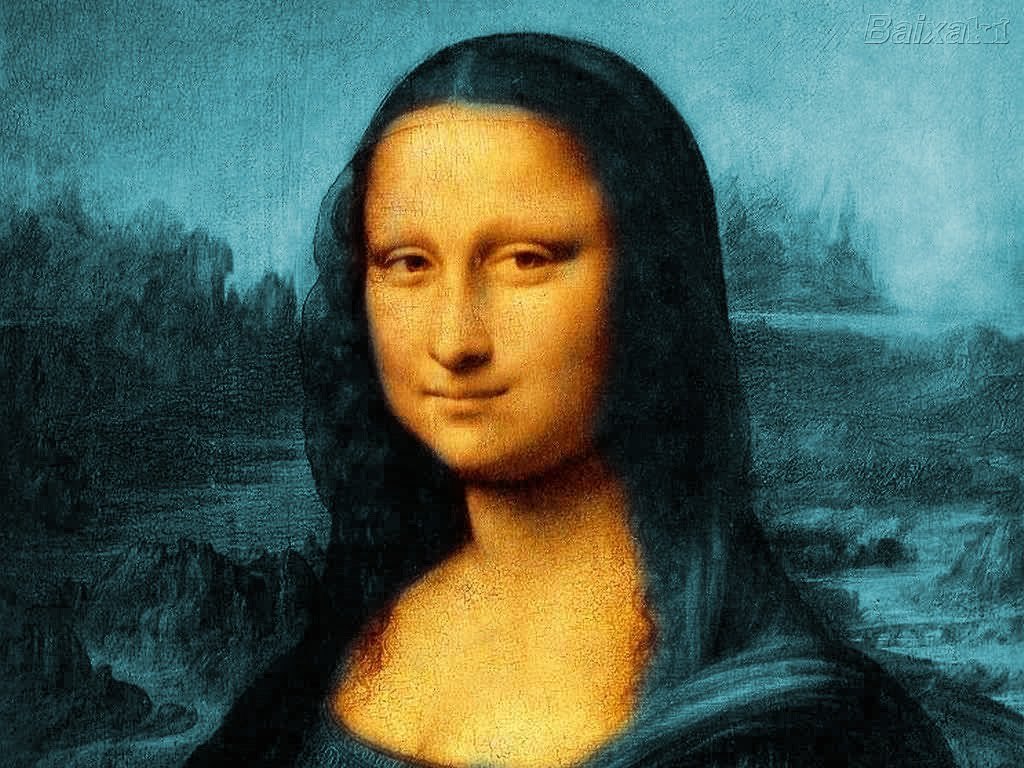
You see, flesh tones exist mostly in the orange range and when you look to the opposite end of the color wheel from that, where does one land?  Why looky here, we have our old friend Mr. Teal.  And anyone who has ever taken color theory 101 knows that if you take two complementary colors and put them next to each other, they will “pop”, and sometimes even vibrate.  So, since people (flesh-tones) exist in almost every frame of every movie ever made, what could be better than applying complementary color theory to make people seem to “pop” from the background.

Digital Intermediate color grading is a recent process that offers unlimited possibilities to the colorist.  When artists are offered a world without boundaries or restrictions, they do some of their worst work; they tend to go more conservative and not less, which is what I believe you are seeing here.