


“It’s A Wonderful Life” and Jimmy Stewart

Special thanks to Amanda K Schalau for sharing this article!
Color Photos by Raymond Tharaldson Vice President / Booyah Productions
Just months after winning his 1941 Academy Award for best actor in “The Philadelphia Story,” Jimmy Stewart, one of the best-known actors of the day, left Hollywood and joined the US Army. He was the first big-name movie star to enlist in World War II.
An accomplished private pilot, the 33-year-old Hollywood icon became a US Army Air Force aviator, earning his 2nd Lieutenant commission in early 1942. With his celebrity status and huge popularity with the American public, he was assigned to starring in recruiting films, attending rallies, and training younger pilots.
Stewart, however, wasn’t satisfied. He wanted to fly combat missions in Europe, not spend time in a stateside training command. By 1944, frustrated and feeling the war was passing him by, he asked his commanding officer to transfer him to a unit deploying to Europe. His request was reluctantly granted.

Stewart, now a Captain, was sent to England, where he spent the next 18 months flying B-24 Liberator bombers over Germany. Throughout his time overseas, the US Army Air Corps' top brass had tried to keep the popular movie star from flying over enemy territory. But Stewart would hear nothing of it.
Determined to lead by example, he bucked the system, assigning himself to every combat mission he could. By the end of the war he was one of the most respected and decorated pilots in his unit.
But his wartime service came at a high personal price.
In the final months of WWII he was grounded for being “flak happy,” today called Post Traumatic Stress Disorder (PTSD).
When he returned to the US in August 1945, Stewart was a changed man. He had lost so much weight that he looked sickly. He rarely slept, and when he did he had nightmares of planes exploding and men falling through the air screaming (in one mission alone his unit had lost 13 planes and 130 men, most of whom he knew personally).
He was depressed, couldn’t focus, and refused to talk to anyone about his war experiences. His acting career was all but over.
As one of Stewart's biographers put it, "Every decision he made [during the war] was going to preserve life or cost lives. He took back to Hollywood all the stress that he had built up.”
In 1946 he got his break. He took the role of George Bailey, the suicidal father in “It’s a Wonderful Life.” The rest is history.
Actors and crew of the set realized that in many of the disturbing scenes of George Bailey unraveling in front of his family, Stewart wasn’t acting. His PTSD was being captured on filmed for potentially millions to see.
But despite Stewart's inner turmoil, making the movie was therapeutic for the combat veteran. He would go on to become one of the most accomplished and loved actors in American history.
When asked in 1941 why he wanted to leave his acting career to fly combat missions over Nazi Germany, he said, "This country's conscience is bigger than all the studios in Hollywood put together, and the time will come when we'll have to fight.”

This weekend, as many of us watch the classic Christmas film, “It’s A Wonderful Life,” it’s also a fitting time to remember the sacrifices of Jimmy Stewart and all the men who gave up so much to serve their country during wartime. We will always remember you!

While fighting in Europe, Stewart's Oscar statue was proudly displayed in his father’s Pennsylvania hardware store. Throughout his life, the beloved actor always said his father, a World War I veteran, was the person who had made the biggest impact on him.

Jimmy Stewart was awarded the Presidential Medal of Freedom in 1985 and died in 1997 at the age of 89.
Color Photos by Raymond Tharaldson - Have a Wonderful Christmas!
Special thanks to Amanda K Schalau for sharing this article!
American News Broadcasting: Farewell President George H. Bush!
American News Broadcasting: Farewell President George H. Bush!: George H.W. Bush was a patriot who loved his country and served it throughout his life. He showed grace and compassion and now will shin...
Rupert Murdoch could buy Fox regional sports networks back from Disney at a discount of billions

The front-runner to buy 22 regional sports TV networks from Disney is the same company that sold them in the first place.
“New Fox,” the company that will remain after Rupert Murdoch sells $71.3 billion worth of 21st Century Fox assets to Disney, is the leading contender to buy back the RSNs it “sold” to Disney as part of the larger transaction, according to people familiar with the matter. Those networks broadcast the games of 44 professional teams from Major League Baseball, the National Basketball Association and the National Hockey League
Formal offers haven’t come in yet. As Sports Business Daily reported, Disney only recently sent out its bid book to prospective buyers. News that Fox was considering buying back the channels was previously reported by The Information.
But people familiar with the process, who asked not to be named because the negotiations are private, say New Fox is the most serious buyer for all the networks. That’s a cleaner outcome for Disney than selling the networks piecemeal, which would bring in smaller buyers and private equity firms.
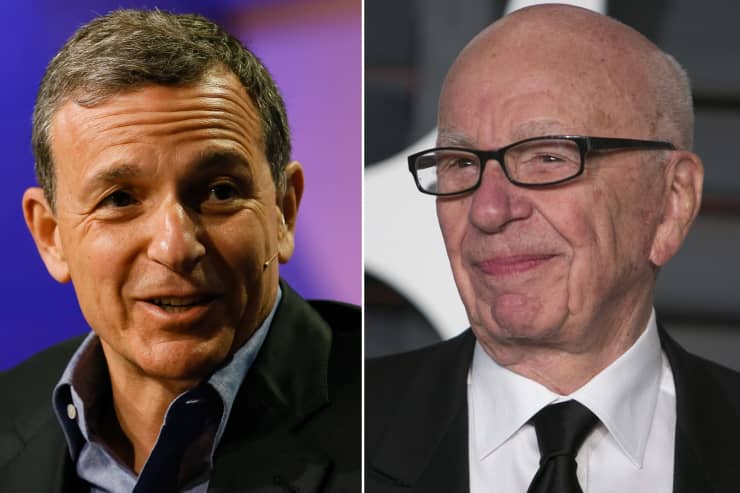
Premium: Bob Iger Rupert Murdoch split
Getty Images
Disney is a motivated seller because it can’t get its larger deal for Fox done without divesting the networks. The Department of Justice forced Disney, which owns ESPN, to sell the networks to alleviate concerns about too much sports programming power in the hands of one company. In fact, the networks might never even change hands, depending on when Disney’s larger deal of Fox closes.
Winning back the sports networks would be a coup for Rupert Murdoch, who could get the RSNs at a lower price than the value at which he sold them to Disney — a price that was driven up nearly $20 billion by Comcast’s rival bid for the bundle of Fox assets. There may also be beneficial tax benefits to Murdoch, related to tax-deductible amortization, one of the people said.
A declining asset that’s worth more to Fox than anyone else.
There are several ironies here.First, while the DOJ forced Disney to sell the RSNs to get the larger deal done, the networks were never a crown jewel asset for Fox, Disney or Comcast. Fox was willing to sell them (and did). Disney took them because it wanted other assets from Fox (its studio, its stake in Hulu, Star India).
Meanwhile, Comcast saw the RSNs as an albatross and was equally willing to divest them, according to people familiar with the companies’ thinking.
Regional sports networks used to be huge value-adds for the cable industry. They carry exclusive broadcasting rights to local games, which come with devoted fan bases. About a decade ago, the networks began to hike carriage fees, knowing cable providers would agree to the higher prices rather than risk alienating customers by blacking out the networks. That led to a steady rise in the cost of cable for consumers. Residents of markets like New York or Los Angeles, which have multiple teams and a handful of RSNs, were paying fees up to $10 a month (baked into their monthly cable bill) whether or not they were watching the games.
In recent years, pay-TV providers, which have seen millions of customers cut the cord, have started to see RSNs differently. Providers have pushed to tier them onto packages that appeal just to sports fans while keeping costs lower for everyone else. This has decreased the value of the networks, which are no longer automatically part of everyone’s basic cable packages.

Several pay-TV providers have dropped regional sports networks, refusing to pay their high programming fees. For instance, SportsNet LA, which broadcasts L.A. Dodgers games, which hasn’t been carried by DirecTV for five straight years.
If Fox ends up with the sports networks again, part of the reason will be that no other large pay-TV distributor -- Charter, AT&T, Comcast or Dish -- saw value in owning the networks. While Sinclair Broadcast Group CEO Chris Ripley has discussed making an offer for the networks with private equity support, it would need quite a bit of help. Sinclair’s market capitalization is just $2.8 billion. The regional sports networks were valued at more than $20 billion, according to a Guggenheim Securities analysis.
It’s still unclear how much New Fox is willing to spend on the networks — or what Disney values them at. What is clear is that Disney needs to sell them.
Disney to divest regional sports networks post-deal.
The second irony is Murdoch can once thank rival Comcast for making him money if he ends up with the networks.
When
Comcast and Disney were jockeying to buy Fox assets earlier this year,
one thing was never in doubt -- Murdoch wanted to sell to Disney.
Several times, Murdoch aligned himself with Disney’s bids against
Comcast.
Yet, the competitive Comcast bids let Murdoch net $19 billion more for his bundle of assets.
Now, Comcast’s participation could help him get the sports networks at a bargain.
Disney originally agreed to buy the Fox assets for $52 billion. Comcast’s rival bids for Fox pushed the price up to $71.3 billion. In that process, it pushed valuation of the RSNs higher, as it did for all of the assets (including 39 percent of British TV provider Sky, which Comcast later agreed to buy).
Disney almost certainly won’t find a buyer that will pay that inflated valuation for just the networks. New Fox’s most likely competitor (barring a competitive bid from a company like John Malone’s Liberty Media) is a private equity firm -- and there’s little chance a leveraged buyout firm could win a bidding war for the RSNs and satisfy its limited partners that it would make a future return on the assets.
(Disney, by the way, will end up getting $15 billion back for selling its 39 percent stake in Sky and possibly about $20 billion for the RSNs, making that $71.3 billion Fox deal look more like $36 billion.)
It’s possible Google, Amazon or another technology company would eventually be interested in the networks for the sports rights. But that seems unlikely. The regional sports networks are tied to a legacy cable system that tech companies typically view as anathema. If Amazon or Google wants regional sports rights, they can just wait until current contracts expire and bid on them then.
The final irony is Fox’s decision to sell the RSNs to Disney may have actually convinced Murdoch that it was better off keeping them. In the months following Fox’s decision to sell, New Fox has clarified its focus, centering itself around news and sports. Netflix publicly praised the company for that decision last week.
It’s possible Fox has come to the conclusion owning the RSNs makes more sense than selling them, even if it didn’t think so 10 months ago.
Disclosure: Comcast is the owner of NBCUniversal, parent company of CNBC and CNBC.com
Yet, the competitive Comcast bids let Murdoch net $19 billion more for his bundle of assets.
Now, Comcast’s participation could help him get the sports networks at a bargain.
Disney originally agreed to buy the Fox assets for $52 billion. Comcast’s rival bids for Fox pushed the price up to $71.3 billion. In that process, it pushed valuation of the RSNs higher, as it did for all of the assets (including 39 percent of British TV provider Sky, which Comcast later agreed to buy).
Disney almost certainly won’t find a buyer that will pay that inflated valuation for just the networks. New Fox’s most likely competitor (barring a competitive bid from a company like John Malone’s Liberty Media) is a private equity firm -- and there’s little chance a leveraged buyout firm could win a bidding war for the RSNs and satisfy its limited partners that it would make a future return on the assets.
(Disney, by the way, will end up getting $15 billion back for selling its 39 percent stake in Sky and possibly about $20 billion for the RSNs, making that $71.3 billion Fox deal look more like $36 billion.)
It’s possible Google, Amazon or another technology company would eventually be interested in the networks for the sports rights. But that seems unlikely. The regional sports networks are tied to a legacy cable system that tech companies typically view as anathema. If Amazon or Google wants regional sports rights, they can just wait until current contracts expire and bid on them then.
The final irony is Fox’s decision to sell the RSNs to Disney may have actually convinced Murdoch that it was better off keeping them. In the months following Fox’s decision to sell, New Fox has clarified its focus, centering itself around news and sports. Netflix publicly praised the company for that decision last week.
It’s possible Fox has come to the conclusion owning the RSNs makes more sense than selling them, even if it didn’t think so 10 months ago.
Disclosure: Comcast is the owner of NBCUniversal, parent company of CNBC and CNBC.com
15 Years Ago Today We Lost This Mega Star!

15
years ago today Johnny Cash left his home here on earth to join June in
their new home on the other side. I had the honor of meeting him and
his amazing family on several occasions. His concerts felt more like a
family jam session than the over produced flash and bang of today's
music events. His persona was overwhelming and yet you felt like part of
an extended family in his presence. I took this image at the end of his
concert. It was the last frame of film I had left on the roll. Long
live Johnny Cash!
https://www.facebook.com/JohnnyCashIsAlive/…
https://www.facebook.com/JohnnyCashIsAlive/…
Hollywood How To: 21st Century Fox Agrees to Higher Offer From Disne...
Hollywood How To: 21st Century Fox Agrees to Higher Offer From Disne...: Disney CEO Bob Iger with Fox’s Rupert Murdoch in a picture distributed by Disney in December, around the time a deal between the ...
21st Century Fox Agrees to Higher Offer From Disney

Disney CEO Bob Iger with Fox’s
Rupert Murdoch in a picture distributed by Disney in December, around
the time a deal between the two companies was first announced.
Photo:
Disney
Disney to pay more and add a cash component; Fox calls pact superior to Comcast’s bid
by Keach Hagey and Erich Schwartzel
Walt
Disney
Co.
DIS 0.99%
raised its offer to purchase most of
21st Century Fox
FOX 7.25%
to more than $71.3 billion in cash and stock, topping an unsolicited offer from rival
Comcast
Corp.
CMCSA 1.77%
and escalating the bidding war for the coveted media properties.Disney’s new offer is far higher than its original deal, $52.4 billion in stock, and surpasses Comcast’s all-cash offer of roughly $65 billion. In addition to having the higher offer, Disney said it also has the regulatory advantage over Comcast in winning a company to help it fight back against new-media competitors like Netflix Inc.
Fox, in a news release, said the new Disney deal “is superior to the proposal” made by Comcast earlier this month. A Comcast spokeswoman had no immediate comment
Disney and Comcast are battling for prized media assets including the Twentieth Century Fox film and TV studio; U.S. cable networks FX and regional sports channels; international assets such as Sky PLC and Star India; and Fox’s one-third stake in the streaming service Hulu.
Fox and Disney were negotiating terms of an amended agreement over the weekend and had the outlines of a deal by Tuesday, though they were nailing down details like the mix of cash and stock, a person close to the situation said.
Disney submitted its bid Wednesday ahead of a Fox board meeting in London, another person familiar with the situation said. Fox Executive Chairman Rupert Murdoch and Disney Chief Executive Bob Iger met to discuss the new pact.
Disney agreed to pay Fox shareholders roughly 50% in cash and 50% in stock. If the current deal closes, Fox shareholders would own 19% of the combined company, compared with 25% under the old deal.
Some observers have said it might make sense for Disney and Comcast to divide the Fox assets among them, but Mr. Iger said that idea is a nonstarter. “We have an agreement in place with [Fox] that precludes that,” he said on a conference call Wednesday.
Disney also has time on its side, Mr. Iger said, because the company’s deal with Fox has undergone several months of regulatory review. “We believe that we have a much better opportunity, both in terms of approval and the timing of that approval, than Comcast does,” he said.
The CEO also highlighted how Fox’s programming would boost his company’s efforts to launch a Disney-branded streaming service next year and directly compete with Netflix. “Direct-to-consumer distribution has become an even more compelling proposition in the six months since we announced the deal. The consumer is voting—loudly,” he said.
Content Creation
As tech firms have increasingly plowed money into original content, Hollywood has been scrambling to keep up

*Compound annual growth rate
†Assumes 60% of FOX’s TV and cable content spending in the pro-forma Disney company, as well as 100% of 20th Century Fox and 100% of Hulu.
Note: Production and programming costs are estimated based on company documents, reported operating expenses associated with marketing and overhead and proxy-based calculations.
Source: RBC Capital Markets;
Graphic by Hanna Sender / The Wall Street Journal.
The fight for Fox is part of a scramble by media, telecom and cable companies to get bigger as the superpowers of the technology industry have disrupted old ways of doing business.
Neither proposed deal includes Fox News, Fox Sports 1, the Fox broadcast network or its television stations. In either scenario, those assets would be spun off into a new company, for the moment dubbed “New Fox.”
On a per-share basis, the new Disney deal values the Fox assets being acquired at $38 a share, compared with Comcast’s offer of $35 and Disney’s original offer of $29.54, based on the last trading day before it was announced.
The fight for Fox is part of a scramble by media, telecom and cable companies to get bigger as the superpowers of the technology industry have disrupted old ways of doing business.
Neither proposed deal includes Fox News, Fox Sports 1, the Fox broadcast network or its television stations. In either scenario, those assets would be spun off into a new company, for the moment dubbed “New Fox.”
On a per-share basis, the new Disney deal values the Fox assets being acquired at $38 a share, compared with Comcast’s offer of $35 and Disney’s original offer of $29.54, based on the last trading day before it was announced.
On Wednesday, Fox’s class A shares rose 7.5% to $48.08, and Comcast shares added 1.8% to $33.39.
Disney shareholders didn’t appear to mind stomaching the higher price as the stock rose 1% to $107.15, but some analysts said the move was foolish. “We didn’t like the deal at the prior price, and we like it substantially less now,” said Doug Creutz of Cowen & Co. The analyst said a Disney-Fox tie-up isn’t the way to win the direct-to-consumer fight.
A continuing bidding war between Disney and Comcast could be a strain on both companies’ balance sheets. Disney Chief Financial Officer Christine McCarthy said the company no longer expects to complete a $20 billion share repurchase announced with the initial deal in December.
Fox’s board and shareholders have had to weigh a number of factors as they measure the offers, including their structure. More stock in the deal has tax advantages for shareholders.
These tax advantages might be particularly large for Fox shareholders, such as the Murdoch family, who have held Fox’s stock for a long time and thus face a potentially large capital gain to pay taxes on if it is sold for cash. Rupert Murdoch and his family have a 17% economic interest in 21st Century Fox. 21st Century Fox and Wall Street Journal-parent News Corp share common ownership.
Disney said the stock part of the deal is expected to be tax-free to 21st Century Fox shareholders.
Other shareholders, particularly the large institutional shareholders that are Fox’s biggest investors, may care less about taxes.
People close to Fox have said that the Murdochs are looking for the best financial deal and are working in the best interests of all shareholders.
As a result of the new Disney offer, Fox postponed the special meeting of shareholders it had originally scheduled on July 10 to “a future date.”
Disney’s offer puts a “collar” on the stock portion, saying Fox shareholders would receive Disney shares equal to the $38 price so long as Disney’s stock price is between $93.53 and $114.32.
Regulatory hurdles have been a consideration. The Justice Department would have to sign off on either deal, and Fox cited regulatory concerns among its reasons for rebuffing Comcast’s initial approach.
However, last week, a judge struck down the Justice Department’s attempt to block AT&T ’s acquisition of Time Warner Inc. Comcast believes the court’s approval of a “vertical” merger between a distributor and a content company should nullify Fox’s regulatory concerns, since a Comcast-Fox tie-up would have similar characteristics, people close to the cable giant say.
Mr. Iger said Wednesday that he still believed a “vertical” merger of the kind Comcast proposed for the Fox assets faced regulatory headwinds.
—Austen Hufford and Dana Mattioli contributed to this article.
Booyah Productions: Motivational Speaker TShane Johnson Pitch Video fo...
Booyah Productions: Motivational Speaker TShane Johnson Pitch Video fo...: PRESS RELEASE: Motivational Speaker TShane Johnson was asked to provide a pitch video for the legendary long running game show Match Gam...
GIRAFFE ATTACKS award-winning movie director while shooting film in South Africa

by Mike Behr
Carlos Carvalho was taken to hospital but died from head injuries after
shooting scenes with a giraffe called Gerald, with witnesses saying the
killer blow came without warning
A SOUTH African
movie director was killed after being hit by a giraffe while shooting
close-ups of the wild animal at a South African game farm.
Carlos Carvalho, 47, was shooting scenes at a British expat's game farm when the giraffe, called Gerald, swung its neck - hitting him on his head and sending him flying.
Focus puller Drikus van der Merwe said: "I was standing right next to Carlos when the giraffe suddenly swung its neck and hit him on his head above his ear and sent him flying about four or five metres through the air."
He said that the animal had initially seemed to be "inquisitive", with the crew shooting close ups of its body and feet.
He added: "Then while Carlos was looking through the camera eyepiece Gerald swung his neck and hit him against his head.
"It came out of nowhere and Carlos didn’t even see it coming. He wasn’t aware of the danger.”

Mike Behr
The giraffe, called Gerald, was being filmed when he hit the film director

A stunned Van der Merwe said he unwittingly
captured the last photos of Carvalho alive, taking a photograph for the
47-year-old's family.
He said: "About five minutes before he got
hit Carlos gave me his phone and asked me to take some photos of him on
the rig for his kids.
"He was talking so highly of them and his wife. I feel so sorry for them."
The film crew had been at Glen Afric, a North West Province game farm where tourists can view and pet wild animals, to capture footage for a German movie Premium Nanny 2.


Mike Behr
The South African game farm he was at is located in Broederstroom, 64km from Johannesburg.
Better known in the movie business as
Brookers Farm, it has also been a popular filming location for hundreds
of international movie and TV shoots for the last 40 years.
It is best known in the UK as the location for the ITV series Wild At Heart.
The show ran for seven series from January 2006 to December 2012.

Mike Behr
"He wanted to get some shots to prove a point. He was trying to excel.
"Gerald was not to blame and would not be put down, said Brooker.
“We are not going to shoot Gerald. He was not in the wrong. I don’t consider him to be a dangerous animal.”
She said unlike Shamba the lion who was shot on another South African game farm after mauling his British owner Mike Hodge on Monday, Gerald the giraffe showed “no animosity, no malicious intent".
She said: "He’s just a huge wild animal and the guy disobeyed safety regulations. I’m very sad for his family. But I’m not one of those people who blames the animals."
Subscribe to:
Posts (Atom)