Steven
Spielberg cheered traditionalists with a spirited defense of the movie
theater, after upsetting some last year with his backing of a new home
streaming proposal (AFP Photo/Mike Coppola)
Steven
Spielberg cheered traditionalists with a spirited defense of the movie
theater, after upsetting some last year with his backing of a new home
streaming proposal (AFP Photo/Mike Coppola)
Los
Angeles (AFP) - He has ruffled feathers with his backing of home
streaming as a model for watching features, but Steven Spielberg cheered
traditionalists with a spirited defense of the movie theater.
The
iconic "Jaws" and "E.T." director, who moved to Los Angeles after
graduating from high school, fondly recounted his formative years in the
industry as he launched a newly-refurbished multi-million dollar cinema
at Universal Studios in southern California.
"This
is an exciting place, just watching it develop into what it has become
over these incredible years, this entire lot, this industry here at
Universal, has made me very proud," said Spielberg, 70, at the opening
of Universal Cinema, one of the world's most technologically advanced
theaters.
"As
a filmmaker, we create movies that invite movie-goers to enter other
worlds, even if it's just for a couple of hours. In the best case
scenario the movie-going experience and its venue are on a par with the
movie that you came to enjoy."
The
sentiment will encourage purists upset by Spielberg's backing last year
of Screening Room, a new at-home streaming movie service proposal that
set some of the industry's most influential filmmakers at loggerheads
over the future of cinema.
The
proposed service, which has yet to sign any exhibitors or distributors,
would include a $150 set-top box that streams new movies in homes the
same day they are released in theaters.
Each
movie would cost $50 and be available to watch for 48 hours with
Screening Room, which counts Sean Parker -- the Napster cofounder and
first president of Facebook -- as a major investor.
While
Peter Jackson, Ron Howard and J.J. Abrams were in favor, those
believing the proposal would hit theater revenues included filmmakers
James Cameron and Christopher Nolan, as well as producer Jon Landau.
Nolan
told CinemaCon, the theater-owners' annual gathering in Las Vegas, in
March that showing his movies on the big screen was his focus.
"The
only platform I'm interested in talking about is theatrical
exhibition," he said, moments after Warner Bros. worldwide marketing and
distribution president Sue Kroll had argued the case for shortening the
gap between theatrical releases and DVD and Blu-ray debuts.
While
Spielberg believes there is room for both home and theatrical movie
releases, he offered a nostalgic window into his own upbringing in the
cinema industry of old Hollywood.
"Universal studios has been a part of my life for as long as I can remember my life," he said.
"I
spent a good part of my youth on the back lot at Universal dreaming
about someday maybe
becoming a filmmaker. And then it happened, first in
picture and eventually in motion picture."
Spielberg
was joined by "Get Out" director Jordan Peele for the opening of
Universal's multi-million dollar renovated AMC Theatre, the first
multiplex in the United States to incorporate cutting-edge Christie
laser projection, Christie Vive audio sound system and Dolby ATMOS
surround sound with reclining seats.
China investment into overseas transactions doubled last year
to peak at $225 billion, according to data firm Dealogic, which tracks
deals across real estate, tech, industry and Hollywood. Now Chinese
acquisitions overseas have slowed to a small fraction of that former
record, especially when it comes to Hollywood. At least one dozen
cross-border, China-U.S. deals in the tech, media and entertainment
space have dried up over the last six months, according to a studio
executive with close ties to investment bankers and private equity
dealmakers involved in these transactions.
Just take note of some of the high-profile deals that have been scrapped over the last year. In March the $1 billion deal by
Chinese real estate and entertainment conglomerate Dalian Wanda Group to
acquire Dick Clark Productions, producer of the Golden Globes and
American Music Awards, collapsed. Regulatory pressures, as well as
payment issues from Wanda's side, were reportedly the cause, according
to one principal involved in the deal. Other China-to-Hollywood deals are in
trouble or have been abandoned. A $1 billion, three-year deal by Chinese
firms Huahua Media and Shanghai Film Group with Paramount Pictures was
intended to help the studio finance films and get released and marketed
in China, but has stalled since former Paramount head Brad Grey was
forced out, though Paramount has insisted in recent press reports it will still happen.
In a related entertainment and
distribution deal that was meant to capitalize on the growing trend
toward live streaming and internet distribution of content, a $2 billion
agreement by Chinese tech and entertainment conglomerate LeEco to
acquire LA-based TV maker Vizio is officially off due to "regulatory
headwinds." The deal's collapse in early April was the result of tighter
currency controls and a crackdown on China-U.S. deals, in addition to a
cash crunch at LeEco, which has been facing financial difficulties and
retrenching after rapid expansion into smartphones and electric
vehicles, according to deal makers involved in the industry. The two
companies will seek to collaborate on content and distribution now that
the acquisition is off.
Meanwhile,
the Middle Kingdom's moves into Hollywood have been facing scrutiny on
Capitol Hill as concerns grow about too much influence and control on
American content by China, a market that blocks social media services Facebook, Twitter
and Instagram on the Chinese internet. In the run-up to the
presidential election, 17 lawmakers pushed for Wanda to be investigated
for violations to the Foreign Agents Registration Act and require it to
publicly disclose its relationship to the Chinese government. More
recently, New York Democratic Senator Chuck Schumer has voiced concerns
over Wanda's Hollywood dealmaking. "Almost no Chinese buyers are
coming to the table," says Chris Fenton, a trustee of the U.S.-Asia
Institute in Washington, D.C., and president of DMG Entertainment Motion
Picture Group in Los Angeles and Beijing. "No Chinese entity wants to
test this," he said, referring to the potential limits of regulatory
scrutiny. Most of Chinese investment in U.S. assets has dried up in the
final hours of negotiation," he said. Fenton helps organize
congressional visits to China. This summer he has added a trip focused
on the high-profile media and entertainment industry.
Behind the Sino-American skepticism
Issues have been brewing on both sides of the ocean
over China-Hollywood deals. As China has turned to Hollywood as part of
its outward reach and bid for soft power, such transactions have been
ensnared by Chinese regulators. China policymakers have been closely
examining transactions that cut across industry lines and command big
price tags, while the Chinese government has tightened controls over
capital outflows to shore up foreign currency reserves and gains in the
yuan currency.
"The Chinese government
crackdowns have made it extremely difficult to get money out," said Rob
Cain, president of advisory firm Pacific Bridge Pictures, focused on
United States and China entertainment markets.
Hollywood is also becoming more
cautious about Chinese capital, Cain said, and also more cautious after
earlier — arguably naive — infatuation. "There's a lot of skepticism now
by Hollywood about these deals," he added, continuing, "On the U.S.
side, there's very little sophistication about how to vet potential
investors. You have to have dedicated teams and be on the ground in
China. It takes a lot to learn the market."
Wanda had led the Hollywood empire building in 2015
by acquiring American film production house Legendary Entertainment,
co-producers of "Jurassic World" and "Godzilla" in a deal for $3.5
billion in cash, adding to a U.S. portfolio that included theater-chain
giant AMC Entertainment and a deal to finance films with Sony Pictures.
China's tech titans Alibaba and Tencent have also been on the hunt in
Hollywood for inroads into this glamorous and high-profile sector, just
as these Chinese leaders have in Silicon Valley for the past few years
for technical know-how.
In 2016, Tencent invested in
movie studio start-up STX Entertainment, while Alibaba announced a
minority stake in Hollywood director Steven Spielberg's Amblin Partners
to produce, distribute and finance films globally and in China. Alibaba
chairman Jack Ma has said the e-commerce company will invest $7.2
billion over the next three years in Hollywood pictures.
"China absolutely wants to have
its own home-grown film business," said Elizabeth Dell, a content
producer at Two Camels Films and head of the China task force of the
Producers Guild of America.
Collaboration may be the hottest ticket
The infatuation between China and Hollywood
probably won't fade soon. As China's middle-class population has
increased and second- and third-tier cities have seen dozens of new
cinemas open, China's box-office revenues have soared. Annual revenues
in China movie tickets have been growing by 35 percent each year since
2011, according to Chinese media and entertainment researcher EntGroup
in Beijing. It's a frontier market that can't be ignored while U.S.
movie ticket sales are relatively flat. China is on track to become the
world's largest box-office market.
"There's definitely a slowdown in or pause on large
deals, but the money is there for movie and TV show collaborations with
Chinese companies."-Elizabeth Dell, head of the China task force of the Producers Guild of America
Moreover, Chinese companies are luring filmmakers
to China to make movies. Wanda's billionaire chairman Wang Jianlin
created a stir in Los Angeles last October by announcing a 40 percent
subsidy for Hollywood to come to China to create films at its
state-of-art movie production facility in the coastal Chinese city of
Qingdao. A number of companies agreed to shoot there, including Arclight
Films and Lionsgate and China Media Capital-backed Infinity Pictures.
Hollywood has turned to
co-productions with a China partner to avoid a quota system that limits
big-budget imported feature films to 34 per year and limits foreign
studios from keeping more than one-quarter of Chinese box-office
revenues.
A recently released U.S.-China
co-production — The Great Wall, by Universal Pictures, Wanda's Legendary
and a LeEco film division — was looked at as a trendsetting deal. It
was the most expensive feature ever shot in China, and it starred Matt
Damon. But the film, which melded Chinese action sequences with
Hollywood-style romances, did not go over well at the box office in
China or the United States, and losses are expected to hit $75 million.
But film producers are still
optimistic about Sino-American-made movies even as the outlook for large
deals remains murky. "You have to make a distinction between capital
for large-scale transactions and capital for productions. There's
definitely a slowdown in or pause on large deals," says producer Dell,
"but the money is there for movie and TV show collaborations with
Chinese companies." — By Rebecca A. Fannin, special to CNBC.com
Bill O'Reilly, longtime host of Fox News's
top-rated show, “The O'Reilly Factor,” will not return to the network.
His departure comes after six women alleged he sexually harassed them.
(Peter Stevenson/The Washington Post)
By Paul Farhi Fox News on Wednesday ended its association with Bill
O’Reilly, the combative TV host and commentator who has ruled cable-news
ratings for nearly two decades and was the signature figure in the
network’s rise as a powerful political player. The
conservative-leaning host’s downfall was swift and steep, set in motion
less than three weeks ago by revelations of a string of sexual
harassment complaints against him. The questions about his conduct
represented yet another black eye to Fox, which had dealt with a sexual
harassment scandal involving its co-founder and then-chairman Roger
Ailes, just last summer.
“After a thorough and careful review of the allegations, the
company and Bill O’Reilly have agreed that Bill O’Reilly will not be
returning to the Fox News Channel,” 21st Century Fox, the channel’s
parent company, said in a statement Wednesday. The ousted host stood by
his earlier denials of the allegations in a statement issued late
Wednesday afternoon. “Over the past 20 years at Fox
News, I have been extremely proud to launch and lead one of the most
successful news programs in history, which has consistently informed and
entertained millions of Americans and significantly contributed to
building Fox into the dominant news network in television,” he said. “It
is tremendously disheartening that we part ways due to completely
unfounded claims.
“But that is the unfortunate reality many of us in the
public eye must live with today. I will always look back on my time at
Fox with great pride in the unprecedented success we achieved and with
my deepest gratitude to all my dedicated viewers. I wish only the best
for Fox News Channel.” The host of “The O’Reilly Factor”
got the news while awaiting a flight back to the U.S. from a vacation
in Italy. His representatives said he was “resigned” to his demise,
having monitored rapidly deteriorating negotiations over his exit over
the past several days. O’Reilly wasn’t directly involved in the
discussions with the family of Rupert Murdoch, which controls Fox and
21st Century Fox; his attorney, Fred Newman, conducted the talks.
In
the end, Newman couldn’t save his client’s job. People close to
O’Reilly said Rupert Murdoch and his sons James and Lachlan, who head
21st Century, effectively decided O’Reilly’s fate with little outside
discussion. O’Reilly’s contract--signed just last month--contains a
clause that enables him to be dismissed under a fixed financial formula,
averting protracted negotiations.
He still seemed to be at the peak of his popularity and
prestige only three weeks ago. His 8 p.m. program, which mixes
discussion segments with O’Reilly’s pugnacious commentary, drew an
average of 4 million viewers each night during the first three months of
the year, the most ever for a cable-news program. His popularity, in
turn, helped drive Fox News to record ratings and profits. O’Reilly was
also the co-author of two books that were at the top of the bestseller
lists in April.
O’Reilly
had previously survived several controversies during his 21 years at
Fox, including a lurid sexual harassment case in 2004 that was fodder
for New York’s tabloid newspapers. He also beat back a wave of headlines
in 2015, when reporters examined his claims about his days as a young
reporter and found them to be dubious. All the while, O’Reilly’s
audience not only stuck with him, but continued to grow. But this time, the intense media coverage surrounding O’Reilly led to a stampede of advertisers away
from O’Reilly’s program, leaving it almost without sponsorship over the
past two weeks. Various organizations, including the National
Organization for Women, called for O’Reilly’s firing,
and intermittent protests began outside Fox News’s headquarters in New
York. Morale among employees at the network reportedly was suffering,
too. The Murdochs also had more than just O’Reilly’s TV
career to consider: The O’Reilly controversy has been casting a shadow
over 21st Century’s $14 billion bid to win the British government’s
approval to buy Sky TV, the British satellite service. Leaving O’Reilly
in place would likely have been a public-relations nightmare for James
and Lachlan Murdoch, the sons who head 21st Century Fox, Fox News’s
parent. The Murdoch family abandoned a 2011 offer for
Sky amid another scandal, the phone-hacking conspiracy perpetrated by
employees of the Murdoch-owned News of the World tabloid in London. A
parliamentary panel later declared Rupert and James Murdoch to be
“unfit” to run a public company — a description they hoped would not be
revived by regulators with the O’Reilly matter hanging over them.
In the wake of the Ailes scandal last summer, the Murdoch
brothers vowed to clean up a workplace environment that women at Fox had
described as hostile under Ailes. In one of their few public statements
on the matter, they said at the time, “We continue our commitment to
maintaining a work environment based on trust and respect.” But
those efforts have seemed unavailing, and at times have even seemed
hypocritical. Since the Ailes scandal erupted, the company has continued
to employ almost all of the senior managers who were in charge when
Ailes was allegedly harassing employees, including Bill Shine, currently
Fox’s co-president. Shine was accused of enabling Ailes’s retaliatory efforts against an accuser, Fox contributor Julie Roginsky, in a sexual-harrassment lawsuit Roginsky filed earlier this month.
In the end, even an endorsement from President Trump could
not save O’Reilly: In an interview with Times reporters on April 5,
Trump called O’Reilly “a good person” and said he should not have
settled the complaints made against him. “I don’t think Bill did
anything wrong,” Trump said. Fox said that Tucker
Carlson, host of a discussion program now airing at 9 p.m., will take
over O’Reilly’s 8 p.m. time slot. “Tucker Carlson Tonight,” in turn,
will be replaced at 9 p.m. by Fox’s 5 p.m. show, “The Five,” starting on
Monday. “The O’Reilly Factor” will continue for the remainder of the
week, with guest hosts Dana Perino and Greg Gutfeld. Martha MacCallum
and Sean Hannity will remain in their current spots at 7 p.m and 10
p.m., respectively, and the 5 p.m. hour will be occupied by a new show,
hosted by Eric Bolling, starting May 1. O’Reilly hasn’t said what he intends to do next.
Bob Iger, chief executive officer of The
Walt Disney Company, walks with Tim Cook, chief executive officer of
Apple Inc., as they attend the annual Allen & Company Sun Valley
Conference, July 6, 2016 in Sun Valley, Idaho.
RBC Capital Markets told investors a mega-merger of Apple and Disney, though unlikely, would make sense strategically for the iPhone maker.
"We
have seen increased discussions among investors regarding 'How could
AAPL gain scale in media/content and what could it do with potential
cash repatriation?" analyst Amit Daryanani wrote in a note to clients
Thursday. "We see a confluence of events
that make an acquisition of DIS a 'greater than 0 percent' probability
event (while odds are low). AAPL's focus on services and its inability
(so far) to replicate its music/iTunes strategy into content/media make
acquiring DIS logical in our view."
Daryanani cited Apple CEO Tim Cook's comments that "deal size isn't a negating factor" for its future mergers and acquisitions. In addition, the analyst noted
the Republican tax repatriation holiday proposals, where corporations
can bring home overseas earnings at a lower tax rate. If this tax reform
becomes law, the iPhone maker will have access to its more than $200
billion held abroad for acquisitions, he said.
Daryanani gave six reasons why Apple may buy Disney:
"Accelerates AAPL's push into services and content."
"Instantly leapfrogs Netflix, Amazon, and YouTube in content and resets the lead with content narrative."
"AAPL has been unable to replicate its music playbook to video."
"Iconic
brand — there are few brands that AAPL could acquire that wouldn't
dilute its iconic presence and customer relationships; DIS would clearly
strengthen (and not dilute) the brand value."
"Even using minimal cost synergy, we see the deal being accretive by 15-20 percent."
"AAPL has been increasingly looking at larger deals and noted that services is a focus."
RBC Capital reiterated its buy rating and $155 price target for Apple, representing 9 percent upside from Wednesday's close.
Don Rickles, in 2007.Credit
Richard Drew/Associated Press
By PETER KEEPNEWS and RICHARD SEVERO
Don
Rickles, the acidic stand-up comic who became world-famous not by
telling jokes but by insulting his audience, died on Thursday at his
home in Los Angeles. He was 90.
The cause was kidney failure, said a spokesman, Paul Shefrin.
For more than half a century, on nightclub stages, in concert halls and on television,
Mr. Rickles made outrageously derisive comments about people’s looks,
their ethnicity, their spouses, their sexual orientation, their jobs or
anything else he could think of. He didn’t discriminate: His incendiary
unpleasantries were aimed at the biggest stars in show business (Frank Sinatra was a favorite target) and at ordinary paying customers.
His
rise to national prominence in the late 1960s and early 1970s roughly
coincided with the success of “All in the Family,” the groundbreaking
situation comedy whose protagonist, Archie Bunker, was an outspoken
bigot. Mr. Rickles’s humor was similarly transgressive. But he went
further than Archie Bunker, and while Carroll O’Connor,
who played Archie, was speaking words someone else had written — and
was invariably the butt of the joke — Mr. Rickles, whose targets
included his fellow Jews, never needed a script and was always in
charge.
One
night, on learning that some members of his audience were German, he
said, “Forty million Jews in this country, and I got four Nazis sitting
here in front waiting for the rally to start.” He said that America
needed Italians “to keep the cops busy” and blacks “so we can have
cotton in the drugstore,” and that “Asians are nice people, but they
burn a lot of shirts.” He might ask a man in the audience,
“Is that your
wife?” and, when the man answered yes, respond: “Oh, well. Keep your
chin up.”
As
brutal as his remarks could be, they rarely left a mark. (“I’m not
really a mean, vicious guy,” he told an interviewer in 2000.) Sidney
Poitier was said to have once been offended by Mr. Rickles’s racial
jokes. But in “Mr. Warmth: The Don Rickles Project,” a 2007 documentary directed by John Landis, Mr. Poitier sang Mr. Rickles’s praises.
Recalling
the first time he saw Mr. Rickles perform, Mr. Poitier said: “He was
explosive. He was impactful. He was funny. I mean, outrageously funny.”
Mr.
Rickles got his first break, the story goes, when Sinatra and some of
his friends came to see him perform in 1957 — in Hollywood, according to
most sources, although Mr. Rickles said it was in Miami. “Make yourself
at home, Frank,” Mr. Rickles said to Sinatra, whom he had never met.
“Hit somebody.” Sinatra laughed so hard, he fell out of his seat.
Mr.
Rickles was soon being championed by Sinatra, Dean Martin and the other
members of the show business circle known as the Rat Pack. Steady work
in Las Vegas followed. But he was hardly an overnight success: He spent a
decade in the comedy trenches before he broke through to a national
audience.
In
1965, he made the first of numerous appearances on “The Tonight Show,”
treating Johnny Carson with his trademark disdain to the audience’s (and
Carson’s) delight. He also became a regular on Dean Martin’s televised
roasts, where no celebrity was safe from his onslaughts. (“What’s Bob
Hope doing here? Is the war over?”)
Mr.
Rickles’s wife, who he said “likes to lie in bed, signaling ships with
her jewelry,” was not immune to his attacks. Neither was his mother,
Etta, whom he referred to as “the Jewish Patton.” But off the stage, he
didn’t hesitate to express his gratitude to his mother for unflaggingly
believing in his talent, even when he himself wasn’t so sure.
Photo
Mr. Rickles performing in Niles, Ill., in 1975.Credit
Don Levitt, via Everett Collection
“She had a tremendous drive,” he recalled in “Mr. Warmth.” “Drove me crazy. But she was like the driving force for me.”
He
shared an apartment with his mother and did not marry until he was
almost 40. After marrying Barbara Sklar in 1965, he saw to it that his
mother had the apartment next door. His wife survives him, as do a
daughter, Mindy Mann, and two grandchildren. Mr. Rickles’s son,
Lawrence, died in 2011.
Donald
Jay Rickles was born in the Jackson Heights neighborhood of Queens on
May 8, 1926, to Max Rickles, an insurance salesman, and the former Etta
Feldman. During World War II, he honed his comedic skills while serving
in the Navy. (“On the ship that I went over to the Philippines,” he told
The New York Times in 2015, “out of 300 men I was the class comedian.”)
After being discharged, he followed his father into the insurance
business, but when he had trouble getting his customers to sign on the
dotted line, decided to try acting.
He
studied at the American Academy of Dramatic Arts in New York, an
experience that he later said gave him a greater sense of himself. But
he found it difficult to get acting jobs and turned to stand-up comedy.
For
a while, he pursued acting and comedy simultaneously. He did his
stand-up act at Catskills resorts and in strip clubs, and his movie
career got off to an auspicious start with a small part in the 1958
submarine drama “Run Silent, Run Deep,” starring Clark Gable and Burt
Lancaster. But the bulk of his film work in the 1960s was in low-budget
beach movies: “Bikini Beach,” “Muscle Beach Party” and “Pajama Party,”
all in 1964, and “Beach Blanket Bingo” in 1965.
Photo
Mr. Rickles and his mother, Etta, celebrating her 74th birthday in Las Vegas in 1975.Credit
Associated Press
By
that time, his comedy career had begun gathering momentum. Focusing
less on prepared material and more on interaction with his audience, he
had found his voice. He was not the first insult comedian — and in fact
an earlier master of the comic insult, Jack E. Leonard, was known to
complain that Mr. Rickles’s act was too similar to his — but he soon
became far and away the most successful.
Bookings
in the late 1950s at the Slate Brothers nightclub in Hollywood and the
lounge of the Sahara Hotel in Las Vegas spread the word. During his
Slate Brothers engagement, Carl Reiner recalled in
“Mr. Warmth,” the
biggest names in show business felt that “if they hadn’t been insulted
by Rickles, they weren’t with it.”
His
appearances insulting celebrities on the Dean Martin roasts and his
sparring matches with Carson cemented Mr. Rickles’s reputation, but his
unscripted brand of humor proved an uneasy fit for weekly television. A
variety show in 1968 and a situation comedy in 1972, both called “The
Don Rickles Show,” were short-lived, as was “Daddy Dearest,” a 1993
sitcom in which he and the comedian Richard Lewis played father and son.
The closest thing to a hit show he had was “CPO Sharkey,” a
Navy
comedy, which aired from 1976 to 1978.
Critics were often not sure what to make of Mr. Rickles. John J. O’Connor of The Times wrote in 1972
that for some his humor “will always remain tasteless,” while for
others “it has its delicious moments of madness.” Tom Shales of The
Washington Post, 26 years later, was more enthusiastic, praising him as
“mythic, timeless, fearless — endowed by the gods with some absurd
miraculous gift.”
No
critic, however thoughtful, could quite explain Mr. Rickles’s
durability in show business, given that until the end of his career he
was peppering his act with slurs and stereotypes long out of favor.
And
yet he not only got away with it, but he also flourished.
Photo
From left, Mr. Rickles, Frank Sinatra and the host, Johnny Carson, on “The Tonight Show” in 1976.Credit
Gene Arias/NBCU Photo Bank, via Getty Images
His
own theory was that he was being rewarded for saying things others
wanted to say but couldn’t. “I’m the guy at the Christmas party,” he
said more than once, “who makes fun of the boss on Friday night and
still has his job on Monday morning.”
Although
Mr. Rickles sometimes expressed regret that he did not have more of a
career as an actor, he did enjoy unexpected cinematic success late in
life. In 1995, Martin Scorsese cast him in “Casino,” with Robert De Niro
and Sharon Stone, and that same year he found a new audience as the
voice of Mr. Potato Head in the hugely successful animated feature “Toy
Story,” a role he reprised in its sequels. “Toy Story 4” is scheduled
for release in 2019, but it is not known whether Mr. Rickles had done
any recording for it before his death. In 2011, he was the voice of a
frog in the movie “Zookeeper” and played the long-lost husband of Betty
White’s character on the sitcom “Hot in Cleveland.”
In
2007, Mr. Rickles published a loosely structured memoir, “Rickles’
Book,” and was the subject of Mr. Landis’s documentary, shown on HBO,
which was built around a performance at the Stardust Hotel-Casino in Las
Vegas shortly before it was torn down.
In
2014, he was the subject of an all-star tribute (inevitably, it turned
out to be more like a roast) broadcast on the Spike cable channel. That
show included appearances by David Letterman, Jerry Seinfeld, Jon
Stewart and Bob Newhart, whose soft-spoken style of comedy could not be
further removed from Mr. Rickles’s, but who he often said was his
closest friend in show business.
Health
problems inevitably slowed Mr. Rickles down, but even after a leg
infection in 2014 affected his ability to walk, he continued performing,
making occasional concert and television appearances. In May 2015, he
was one of the last guests on “Late Show With David Letterman.”
As recently as 2007, the year he turned 81, Mr. Rickles had been working, by his count, about 75 nights a year.
“The
only way I would stop is if my health goes, God forbid, or the audience
isn’t with me anymore,” he told The Times that year. “Besides, I got to
keep going. My manager told me he has to put his kid through college.
His kid is 10 years old.”
In
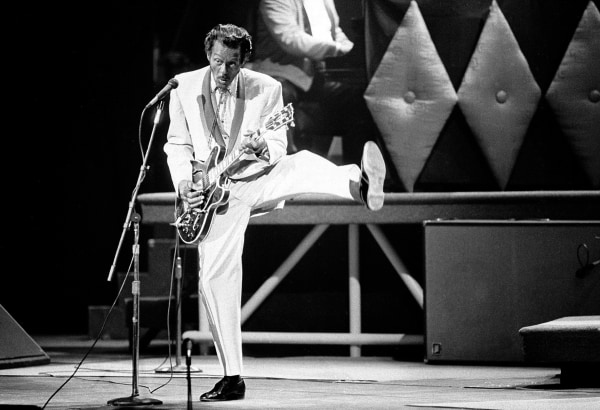
this Oct. 17, 1986 file photo, Chuck Berry performs during a concert
celebration for his 60th birthday at the Fox Theatre in St. Louis, Mo. James A. Finley / AP
byKalhan Rosenblatt
Revolutionary blues singer Chuck Berry, often
referred to as the "poet laureate" and "father" of rock 'n' roll, died
Saturday, police in Missouri said. He was 90.
Officers responded to Berry's home outside St.
Louis on Saturday afternoon and found him unconscious, the St. Charles
County police said on Facebook. First responders were unsuccessful in
reviving him and pronounced him dead at 1:26 p.m. local time.
One of the first inductees into the Rock & Roll Hall of Fame,
Berry wove together beguiling narratives, fusing rhythm and blues with
country and western — transfixing the nation.
Ted Nugent's amazing tribute to the legendary Chuck Berry.
In 2000, President Bill Clinton called Berry "one of the 20th Century's most influential musicians."
Known for chart-toppers such as "Johnny B
Goode," "Roll Over Beethoven" and "Brown Eyed Handsome Man," Berry's
career rocketed in the 1950s after signing a record deal with Chess
Records at the behest of musician Muddy Waters, according to Rolling Stone.
In
this Oct. 17, 1986 file photo, Chuck Berry performs during a concert
celebration for his 60th birthday at the Fox Theatre in St. Louis, Mo. James A. Finley / AP
His first hit, "Maybellene," spent nine weeks in the No. 1 spot on the Billboard
R&B chart and also rose to No. 5 on the pop charts. Berry reshaped
the 1950s with a unique sound that appealed to both sides of a racially
divided country.
"I made records for people who would buy them.
No color, no ethnic, no political — I don't want that, never did,"
Berry told the New York Times in 2003.
The Rock & Roll Hall of Fame said in a statement Saturday that Berry "created the rock sound."
"Chuck Berry is rock and roll. The undisputed
original poet laureate, he influenced every rock and roll artist after
him and every guitarist that ever plugged in," hall of fame President
and CEO Greg Harris said in a statement.
"Today, we celebrate his poetry, his artistry
and his massive contributions to 20th century culture," Harris said.
It's fitting that he was the first person inducted into the Rock &
Roll Hall of Fame. Rock and roll as we know it would not exist without
him. Hail Hail, Rock and Roll. Hail Hail, Chuck Berry."
Many of the biggest names in rock 'n' roll have cited Berry as an inspiration thanks to his earworm tunes.
John Lennon once said: "If you had tried to try and give rock 'n' roll another name, you might call it 'Chuck 'Berry.'"
The Twitter account run by Lennon's estate was
among those paying tribute to the legendary musician Saturday. Beatles
drummer Ringo Starr also expressed his condolences: "R I P. And peace
and love Chuck Berry Mr. rock 'n' roll music."
Leonard Cohen believed, "all of us are
footnotes to the words of Chuck Berry," while Bob Dylan dubbed him the
"Shakespeare of rock 'n' roll," Peter Guralnick recalled in Rolling Stone in October 2016.
Berry's signature duck walk was adopted by the likes of admiring bands such as The Who and AC/DC.
Despite mesmerizing the country with his
infectious hooks and rhythm, he was temporarily pulled from the
spotlight in 1959 when he was arrested for violating the Mann Act by
driving an underage girl across state lines from Texas to his native
Missouri, according to Biography.com. He spent two years in federal prison.
Chuck Berry performs at B.B. King Blues Club & Grill on Dec. 31, 2011 in New York City. Bobby Bank / WireImage
As a teenager, Berry — born Charles Anderson
Edward Berry to Martha and Henry Berry in St. Louis — was convicted of
an armed robbery and spent 1944 to 1947 in reform school.
After his release, Berry worked an assembly
line and studied cosmetology, before finding his place in American
history with a guitar in his hands and a captain's hat on his head.
Later in life, Berry would serve another
prison stint after running into trouble with the Internal Revenue
Service, Rolling Stone reported.
But he would always return to the stage, even as he aged, playing shows into his mid-80s.
On his 90th birthday, Berry announced he was
releasing his first LP in 38 years, slated to hit stores this year. He
dedicated the album to his wife of 68 years, Themetta "Toddy" Berry,
whom he is survived by.